Your Diwali 2026 WhatsApp Campaign Plan
Diwali falls on 8 November. Here is the five-week runway — template approvals, tier headroom and a day-by-day message calendar for the festive window.
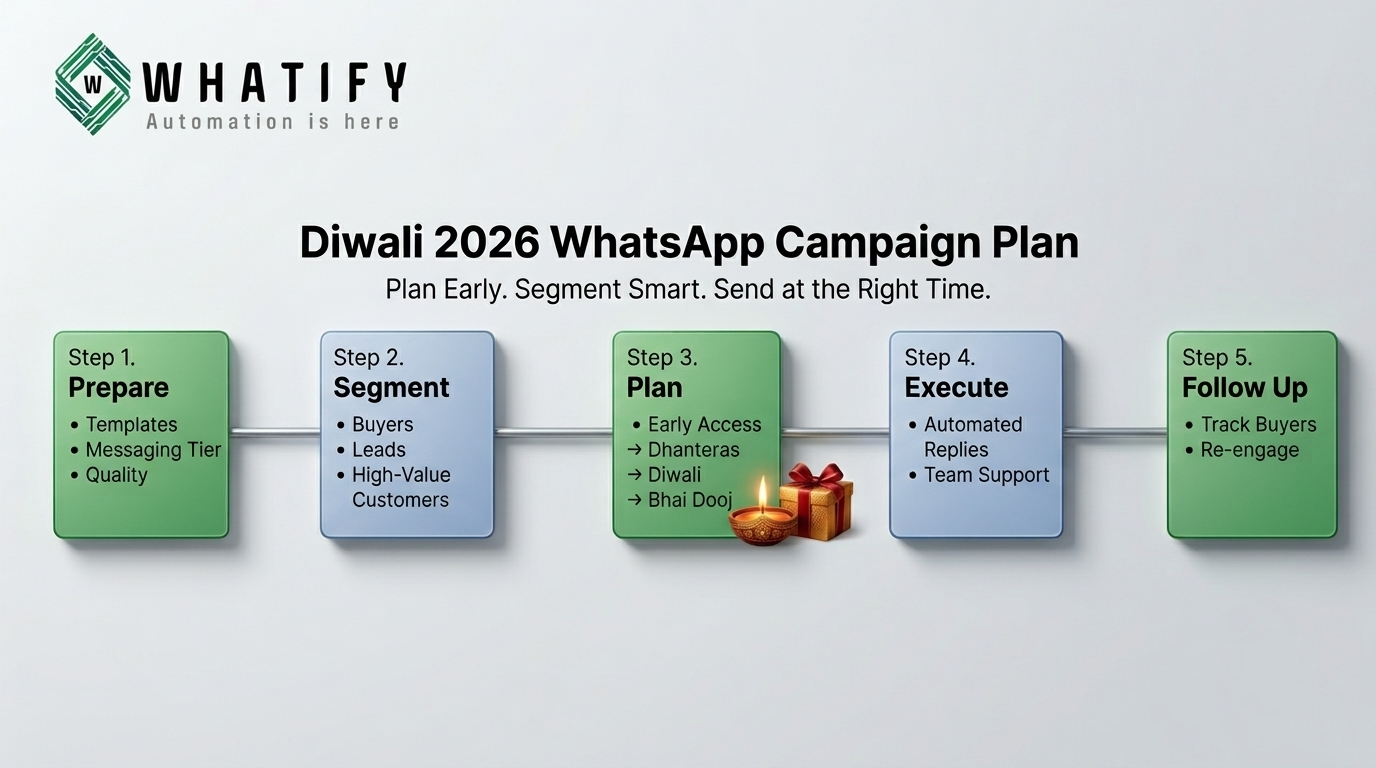
Diwali 2026 falls on Sunday 8 November, with Dhanteras on Friday 6 November and Bhai Dooj closing the window on Tuesday 10 November.
That gives you five weeks. It sounds like plenty. It is not, because two of the things that can stop your campaign — template approval and messaging tier headroom — are outside your direct control and cannot be fixed in the final week.
Weeks 1–2: the things that can block you
Check your messaging tier now. Your tier caps how many unique customers you can message in 24 hours. If you are on an entry tier and plan to reach 20,000 people over the festive window, the campaign fails regardless of how good the creative is. Tiers scale with consistent sending and a healthy quality rating, so the increase has to be earned before November, not requested during it. Our guide to messaging limits and tiers explains how the ladder works.
Check your quality rating. A rating that is already Medium going into a high-volume period is a warning. Festive sending pushes volume up, and volume amplifies whatever your list is already doing. If the rating is soft, fix it in October — see quality rating recovery.
Submit templates early. Templates need approval, approval is not instant, and rejections need resubmission. Submit every festive template by mid-October. Our post on template rejection reasons covers what gets refused.
Submit more variants than you need. A rejected template on 4 November is a problem; a rejected template on 15 October is an afternoon.
Week 3: segmentation
The single biggest determinant of festive performance is who receives what. Blasting one offer to the whole list is what produces block spikes.
|
Segment |
Message angle |
|
Bought in last 90 days |
Early access, before the general announcement |
|
Bought 90–365 days ago |
Return offer with a reason to come back |
|
Bought over a year ago |
Treat as cold — one careful message only |
|
Browsed but never bought |
Category-specific, not a general sale message |
|
High value |
Personal, low discount, human follow-up |
Different segments should receive a different number of messages. Recent buyers can take more. Dormant contacts should receive one — our guide to re-engaging dormant contacts covers the risk.
Week 4: the festive calendar
A workable shape for the window, adjusted to your category:
|
Date |
Message |
|
Mon 26 Oct |
Early-access announcement to recent buyers only |
|
Fri 30 Oct |
Main festive offer to active segments |
|
Wed 4 Nov |
Dhanteras preview — strongest for jewellery, electronics, vehicles, home |
|
Fri 6 Nov |
Dhanteras day — time-bound, short |
|
Sat 7 Nov |
Last-delivery-date reminder, if you ship |
|
Sun 8 Nov |
Greeting only. No selling on Diwali day |
|
Tue 10 Nov |
Bhai Dooj gifting, if relevant |
|
Thu 12 Nov |
Post-festive extension for non-openers only |
Two rules hold across categories. Do not send promotional messages during Lakshmi Puja on the evening of 8 November — in Delhi the muhurat runs roughly 5:54 to 7:50 pm. And do not exceed roughly two marketing messages per contact per week, even in festive season.
Week 5: operational readiness
Campaigns generate replies, and from 1 October 2026 service replies inside the 24-hour customer window are chargeable at market rates. Festive support is a real cost line now — see our analysis of the October change.
Practical preparation:
· Staff the inbox for the window, including the weekend of 7–8 November
· Automate the top five festive questions: delivery date, offer terms, stock, order status, returns
· Set a realistic away message for Diwali day
· Brief the team on escalation before the volume arrives
Budget it before you build it
Festive volume plus marketing-category rates is the most expensive month of most calendars. Model it: plan fee, plus volume by category at the applicable rate, plus 18% GST. As an illustration, 8,000 marketing and 2,000 utility messages on a mid-tier plan lands near ₹13,200 for the month. Our cost per message guide has the full working, and current rates are published.
After 10 November
The festive list is your most valuable acquisition of the year. Tag every buyer with what they bought and what they responded to. That segmentation is what makes next Diwali — Friday 29 October 2027 — considerably easier.
If you are setting up before the window, start a 14-day free trial in October rather than November. Verification and approvals take time you will not have later.
Frequently Asked Questions
Diwali 2026 falls on Sunday 8 November, with Lakshmi Puja that evening. The wider festive window runs from Dhanteras on Friday 6 November through Bhai Dooj on Tuesday 10 November, with Choti Diwali on 7 November and Govardhan Puja on 9 November.
At least five weeks. Two constraints cannot be fixed at the last minute — template approval takes time and may need resubmission after rejection, and your messaging tier only increases through consistent sending and a healthy quality rating over preceding weeks
Keep to roughly two marketing messages per contact per week even in festive season, and vary the count by segment. Recent buyers tolerate more contact; dormant contacts should receive one carefully written message rather than a full sequence.
Send a greeting rather than an offer, and avoid the Lakshmi Puja window entirely — in Delhi that runs roughly 5:54 to 7:50 pm on 8 November. Promotional messages during puja read as intrusive and are a reliable way to earn blocks.
It can. Your tier caps how many unique customers you can message in 24 hours, so a large festive list against an entry tier will simply not deliver. Check your current tier in October and build sending volume gradually so the limit rises before November.
Ready to automate your WhatsApp marketing?
Start your 14-day free trial today. No credit card required.
Start Free Trial