Re-Engaging Dormant Contacts Without Getting Blocked
A dormant list looks like free revenue and behaves like a landmine. How to decide who is worth waking, what to send them, and when to let a contact go.
Every business accumulates them: contacts who bought once, or enquired once, and then went quiet. The list grows, and eventually someone suggests messaging all of them.
That instinct has ended more WhatsApp accounts than any other single campaign type. Dormant contacts have the highest block rate of any segment, and blocks damage the number you use for everyone else.
Re-engagement can work. It has to be done narrowly.
Sort dormancy by age, not by one label
"Inactive" covers wildly different situations. Split the list:
|
Time since last interaction |
Reality |
Approach |
|
3–6 months |
Normal purchase gap in many categories |
Treat as active; ordinary campaigns are fine |
|
6–12 months |
Genuinely lapsed |
One re-engagement message |
|
12–24 months |
Cold; they may not recall you |
One message, only if consent is documented |
|
Over 24 months |
Treat as gone |
Do not message |
The over-24-month group is where accounts get damaged. The perceived value is high because the list is large. The actual value is close to zero, and the block rate is not.
Before you send, remove
· Anyone who opted out, in any wording
· Contacts whose consent you cannot evidence
· Numbers that repeatedly failed delivery
· Anyone who complained or was refunded unhappily
If consent records are thin, that is the real problem to solve first — see DPDP consent records for what a defensible record contains.
One message. Not a sequence.
The single most important rule. A dormant contact who ignores your first message will not be persuaded by the second — they will block on the second.
Send one. Read the response. Only continue with people who responded.
What the message should do
Acknowledge the gap. Pretending they are an active customer reads badly. A short, plain "it's been a while" is more effective than enthusiasm.
Give a reason for the message that is not just a discount. New range, a change they asked about, a service they used before now improved. Discount-only reactivation attracts discount-only buyers and trains the rest to wait.
Make responding trivial. Buttons, not open questions. Two options is plenty.
Include the exit. Making opt-out easy in a re-engagement message is protective. Someone who taps "no thanks" has just saved you from a block, which is the far more damaging signal — see the broadcast best practices for why.
A workable shape:
"Hi Priya — it's been a while since your last order with us. We've added [category] since then. Worth a look?
· Show me
· No thanks"
Send in small waves
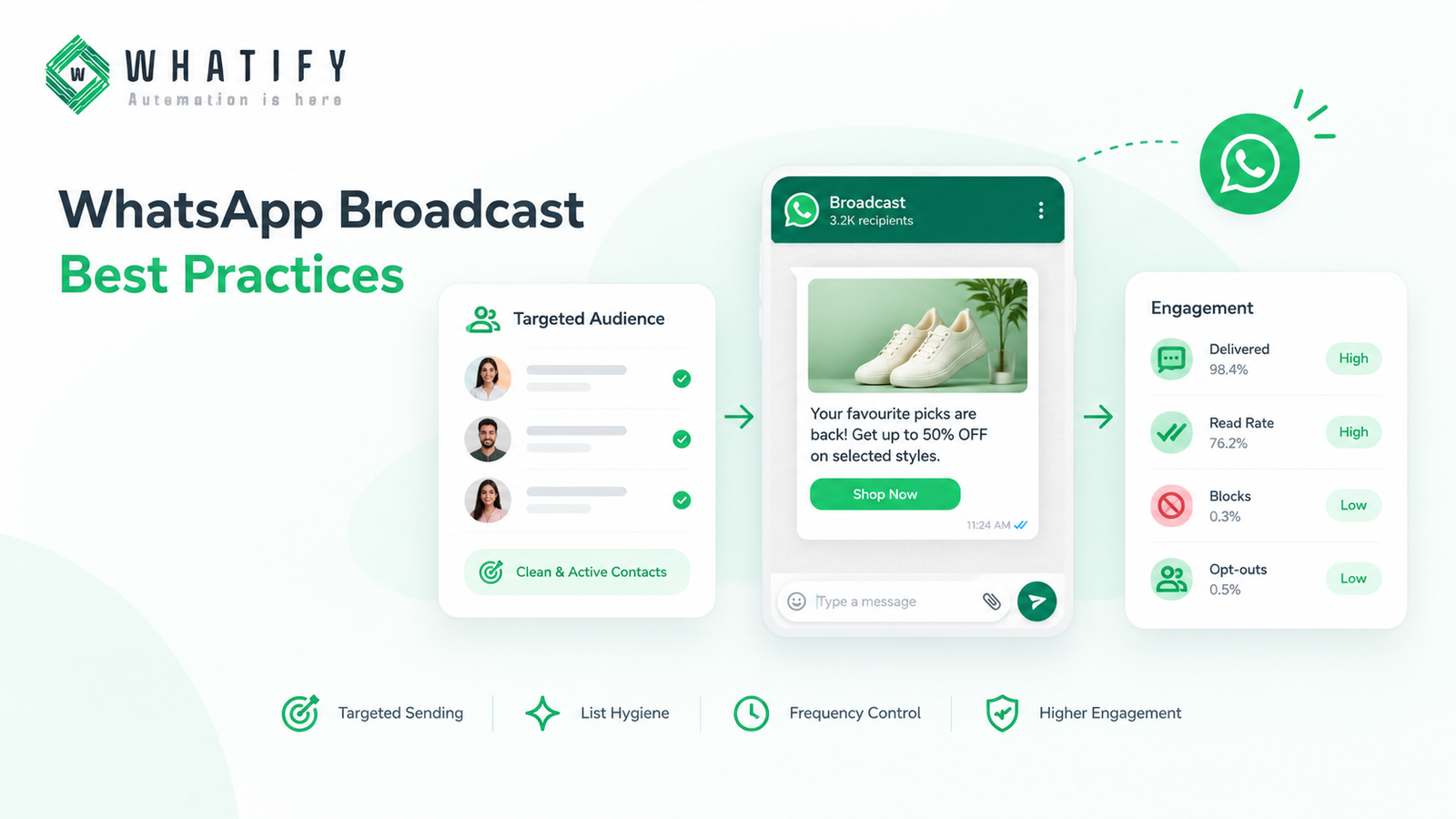
Do not send to 10,000 dormant contacts at once. Send 500. Wait a day. Check block rate, opt-out rate and reply rate.
If block rate on the wave is materially above your normal campaign level, stop and reconsider the segment. Continuing at scale after a bad first wave is how a quality rating drops from High to Low in a week — recovery is slower than the damage, as our quality rating recovery guide sets out.
Track it against your own baseline rather than a published benchmark. Your normal is the only meaningful comparison. The campaign metrics guide covers how to establish one.
Read the three signals
Replied or tapped through — move them back to your active list and follow up normally.
Delivered, read, no response — leave them alone. They saw it and declined. A second message converts almost nobody and costs you goodwill.
Blocked or opted out — remove permanently and treat it as information about the segment, not just the individual.
Know when to stop
A contact who has ignored two re-engagement attempts across separate campaigns is finished. Keeping them on the list costs money on every send, drags engagement ratios down and adds block risk.
Deleting dormant contacts feels like losing an asset. A list of 3,000 engaged contacts is worth more than 30,000 mostly dead ones — it costs less to message, performs better, and protects the number.
Prevention is cheaper
Most dormancy is avoidable. Contacts go quiet when nothing useful arrives between purchases. Regular, relevant, low-frequency contact — order updates, genuinely useful information, occasional well-targeted offers — keeps a list alive far more cheaply than reactivating it later.
Whatify's segmentation and analytics let you spot contacts drifting toward dormancy while they are still reachable. Start a free trial and check what proportion of your list has already gone quiet.
. EXTERNAL SOURCES
1. Meta — WhatsApp Business Messaging Policy: opt-in validity and expectations for business-initiated contact. https://business.whatsapp.com/policy
2. Meta — Quality rating and messaging limits: how blocks affect account standing. https://developers.facebook.com/docs/whatsapp/messaging-limits/
Frequently Asked Questions
It depends on your purchase cycle, but a useful split is 3 to 6 months as a normal gap, 6 to 12 months as genuinely lapsed, 12 to 24 months as cold, and beyond 24 months as gone. The last group should not be messaged at all.
One. A dormant contact who ignores the first message will not be convinced by the second — they will block on it. Send a single message, read the response, and continue only with contacts who actually replied or tapped through.
The recipient has not heard from you in months, may not recall opting in, and receives an unexpected promotional message. That combination produces the highest block rate of any segment, and blocks damage the quality rating of the number you use for every other customer.
Not as the only reason for the message. Discount-only reactivation attracts discount-only buyers and teaches the rest of your list to wait for offers. A new range, an improvement they asked about, or a genuinely relevant update usually performs better and costs less.
Send in small waves of a few hundred contacts, wait a day, and compare block rate, opt-out rate and reply rate against your own normal campaign baseline. If blocks are materially higher, stop and reconsider the segment rather than continuing at scale.
Ready to automate your WhatsApp marketing?
Start your 14-day free trial today. No credit card required.
Start Free Trial