WhatsApp for Gyms: Trials, Renewals and Retention
Gyms do not lose members at renewal. They lose them in week three. Messaging flows for trial conversion, the attendance drop-off window, and renewals that land early.
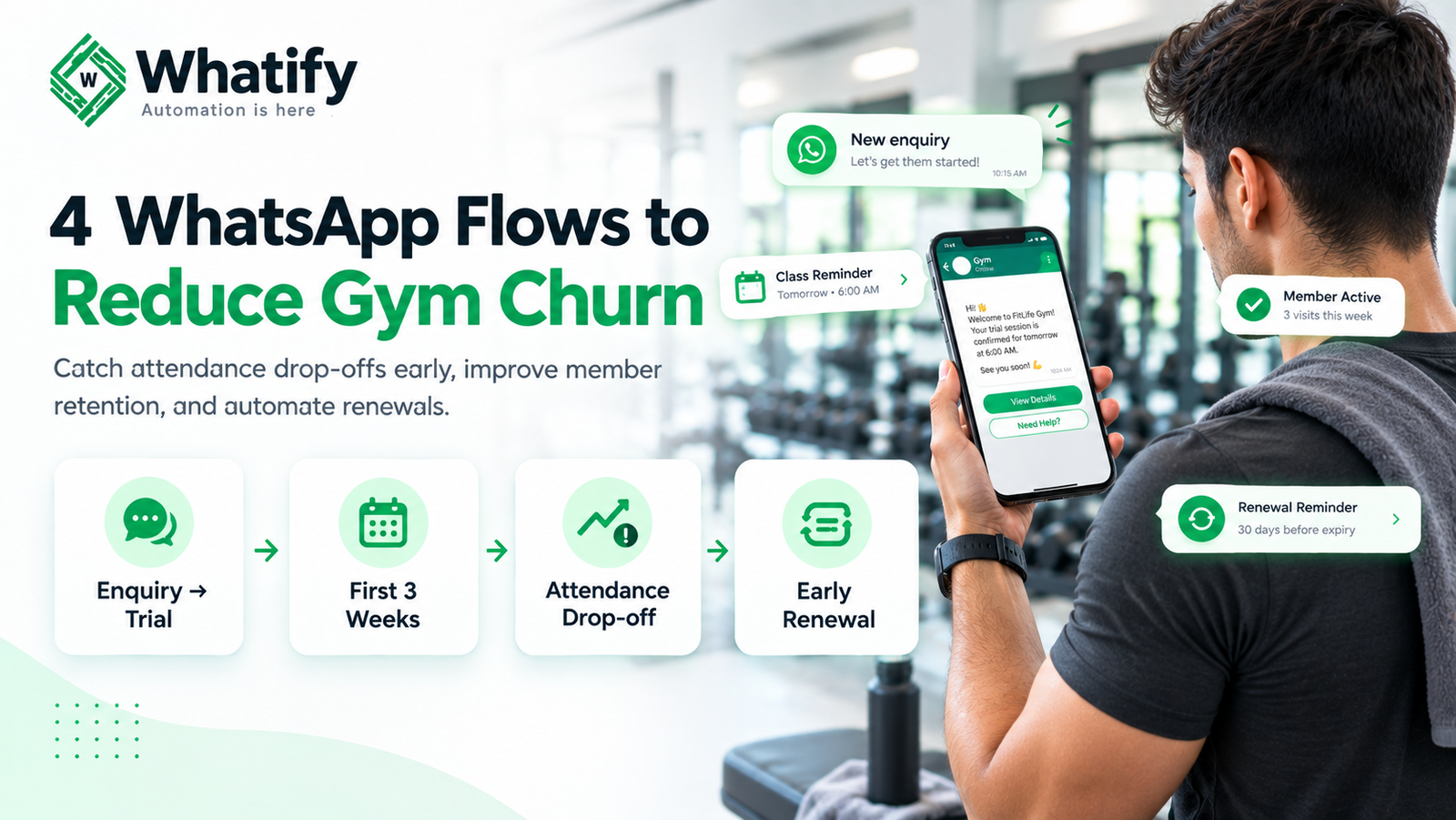
Gyms measure churn at renewal, which is far too late. The decision not to renew is usually made weeks earlier, in the quiet stretch when someone stops turning up and nobody notices.
Messaging works for gyms because it can catch that moment. Here are the four flows that matter, in the order they occur.
Flow 1: Enquiry to trial
Fitness enquiries are impulsive. Someone sees an ad on Sunday evening, messages, and if nobody replies until Tuesday the impulse is gone.
Automate the first response:
1. Acknowledge instantly.
2. Ask what they are after — weight loss, strength, general fitness, a specific class. Buttons, not free text.
3. Offer a trial slot as buttons rather than asking them to call.
4. Send location, timings and what to bring.
Then hand to a human with the answers attached. A trainer who opens the chat already knowing the person wants weight training at 6am has a much easier conversation.
Tag the goal. It determines every message that follows.
Flow 2: The first three weeks
Trial-to-member conversion and early retention are the same problem: does the person build a habit before motivation fades?
A light onboarding sequence:
· Day 1 — welcome, timings, how to book classes, who to ask for help
· Day 3 — a check-in tied to their stated goal
· Day 7 — first-week acknowledgement, plus one relevant class suggestion
· Day 14 — offer a short session with a trainer to review form or plan
Keep these short and useful. Nobody joined a gym to read a newsletter.
Flow 3: The attendance drop-off trigger
The highest-value automation a gym can run, and the one almost nobody has.
Trigger a message when a member's attendance falls below their own established pattern — for instance, no visit in ten days for someone who previously came three times a week. Not a generic "we miss you" blast, which reads as marketing. Something specific and low-pressure:
Hi {{1}}, we haven't seen you in a couple of weeks. Everything alright? If your schedule has changed, we can suggest class timings that fit better.
[Suggest timings] [I'll be back soon] [Talk to a trainer]
Two things make this work. It arrives during the drift, not after it. And it offers a solution to the actual problem — usually a timing conflict — rather than guilt.
Route "Talk to a trainer" to a human the same day.
Flow 4: Renewal, started early
A renewal message sent the week a membership expires is a payment request. Sent four weeks earlier, alongside a note on what the member achieved, it is a different conversation.
A workable sequence:
· 30 days before expiry — renewal window opens, with any early-renewal benefit
· 7 days before — reminder with a payment link
· On expiry — final reminder
· 7 days after — one win-back message, then stop
Segment by attendance. A member who trains four times a week needs a one-line reminder. A member who has barely attended needs a conversation with a trainer before any renewal ask, because sending them a payment link is how you confirm their decision to leave.
Class and slot reminders
For studios running scheduled classes, a reminder the evening before with a Cancel option protects capacity. A cancelled spot released at 9pm can be offered to a waitlist; an empty mat at 7am cannot. This is the same mechanic clinics use — see WhatsApp for clinics for the full cascade.
Costs and frequency
Renewal reminders and class reminders are typically utility templates. Promotional messages — new offers, referral pushes, festival packages — are marketing templates and cost more.
Frequency discipline matters here because gym members are already receiving a lot of fitness marketing. Keep promotional sends to roughly two per contact per week at the absolute maximum, and considerably fewer in practice. Our quality rating recovery playbook covers the consequences of getting this wrong.
What to measure
· Enquiry-to-trial conversion
· Trial-to-member conversion
· 90-day retention, which predicts renewal far better than satisfaction surveys
· Reactivation rate from the drop-off trigger
· Renewal rate, split by attendance band
The attendance-band split is the useful one. It tells you whether your retention problem is a product problem or a communication problem.
Whatify supports segmented contact lists, scheduled sequences and trigger-based sends from a sheet or webhook. Start a 14-day free trial and build the drop-off trigger first — it is the flow with the shortest payback.
EXTERNAL SOURCES
1. Meta — Message template guidelines: utility versus marketing categorisation for renewal and promotional messages. https://developers.facebook.com/docs/whatsapp/business-management-api/message-templates/
2. Meta — WhatsApp Business Messaging Policy: opt-in and frequency expectations for business-initiated messaging. https://business.whatsapp.com/policy
Frequently Asked Questions
Reply instantly with an automated flow that asks the person's goal using buttons, offers a trial slot they can book without calling, and sends location and timings. Then hand to a trainer with the answers attached, so the human conversation starts with context rather than basics.
An attendance drop-off trigger. When a member's visits fall below their own established pattern, send a low-pressure message offering alternative class timings. It catches people during the drift, when the renewal decision is actually being made, rather than at expiry when it has already been made.
Open the renewal window around thirty days before expiry, remind seven days before with a payment link, send a final reminder on expiry, and one win-back a week later. Segment by attendance — a lapsed member needs a trainer conversation before any payment request.
Keep promotional messages to a small number per contact per week at most, and fewer in practice. Utility messages such as class and renewal reminders are expected and tolerated better. Gym members already receive heavy fitness marketing, so frequency discipline protects your quality rating.
A reminder the evening before with a cancel option lets members release a spot in time for it to be offered to a waitlist. The value is less in reducing no-shows than in converting them into refillable cancellations, which protects class capacity and revenue.
Enquiry-to-trial conversion, trial-to-member conversion, ninety-day retention, reactivation rate from the drop-off trigger, and renewal rate split by attendance band. The attendance split reveals whether a retention problem is about the gym itself or about communication.
Ready to automate your WhatsApp marketing?
Start your 14-day free trial today. No credit card required.
Start Free Trial