WhatsApp Broadcast Best Practices That Protect Your Number
Most broadcast advice is about copywriting. The things that actually decide whether a campaign works are list quality, segment size, frequency and send timing.
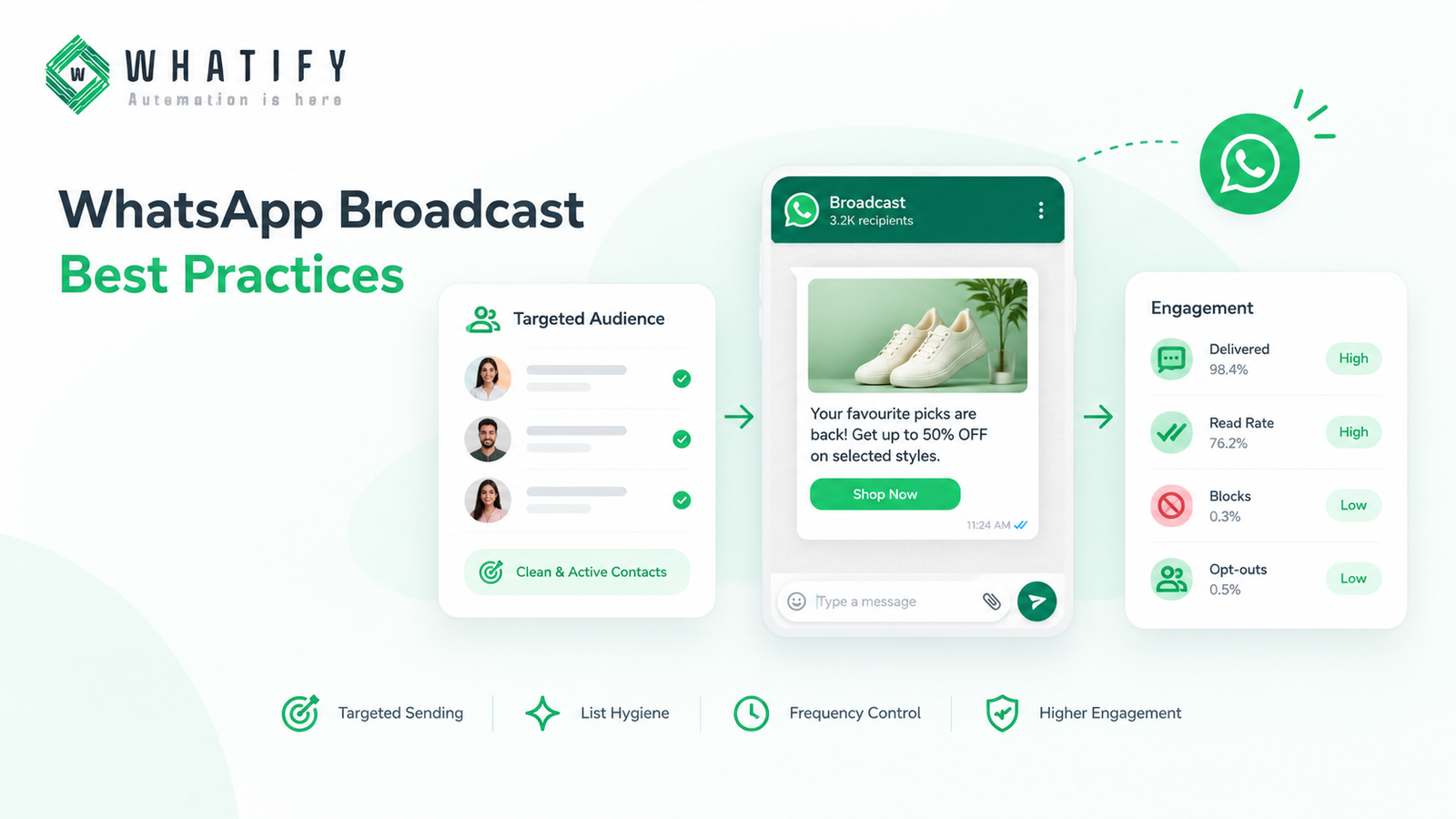
A WhatsApp broadcast is not an email blast with a higher open rate. Email punishes bad sending with a spam folder. WhatsApp punishes it with blocks, a falling quality rating, and eventually a messaging limit that shrinks under you.
These practices are ordered by how much they affect the outcome. The first four matter more than anything you write.
1. Send to fewer people
The instinct is to maximise reach. The correct instinct is the opposite.
A message sent to 2,000 people who are plausibly interested outperforms the same message sent to 20,000 people, and does not damage the account. Blocks and opt-outs are driven by relevance, and relevance falls as the list grows.
Start every campaign by asking who should not receive this. That question builds better segments than asking who should.
2. Fix list hygiene before anything else
Remove before you send:
· Contacts who have never engaged with any message
· Anyone who opted out, in any form of words
· Contacts older than a year with no interaction
· Numbers that have hard-failed delivery repeatedly
A list that is 40% dead does not just waste money on undelivered or ignored messages. It drags your engagement ratios down, and those ratios are what Meta's quality signals respond to.
3. Cap frequency and hold the cap
Roughly two marketing messages per contact per week is a workable ceiling for most Indian SMB lists, lower for high-consideration purchases. The cap needs to be enforced across campaigns, not per campaign — three teams each sending "just one" is four messages a week to the same person.
Utility messages triggered by a real event, like an order update, sit outside this. Customers do not experience those as marketing.
4. Time the send properly
Avoid before 9am and after 9pm. Avoid meal times. For most consumer categories 11am–1pm and 5–7pm perform reasonably; for B2B, mid-morning on a weekday.
Test against your own data rather than trusting a generic table, including this one. Your customers are not the average.
5. Write for the notification, not the message
Most recipients decide from the preview. The first line has to carry the value — no greeting preamble, no brand throat-clearing. Say the thing.
Keep the message short. Use one call to action, not three. Buttons outperform links because they are one tap and they give you cleaner click data.
6. Get the template category right
Marketing and utility are priced differently and judged differently. A promotional message submitted as utility will be recategorised or rejected, and repeated miscategorisation is a quality problem. Our post on template categories and pricing covers the boundary, and rejection reasons covers what gets refused.
7. Make opting out easy
This feels counterproductive and is not. An opt-out is a clean exit; a block is a durable negative signal against your number. Give people the easier route out, honour it immediately, and keep the record. Consent handling is also a legal obligation as India's data protection rules phase in — see DPDP consent records.
8. Watch block rate above everything else
Delivery and read rates tell you the message arrived. Block rate and opt-out rate tell you whether to keep going. A rising block rate after a campaign is the earliest reliable warning of trouble ahead, and it precedes a quality rating drop rather than following it.
Track the nine metrics in our campaign metrics guide, but if you only watch one, watch blocks.
9. Test on a small segment first
Send to 5–10% of the intended audience. Wait two hours. Check delivery, read, replies and blocks. Then send the rest, or fix it first.
This single habit prevents most campaign disasters, and it costs a two-hour delay.
A pre-send checklist
1. Segment defined by behaviour, not by "everyone"
2. Opted-out and dead contacts removed
3. Frequency cap checked across all campaigns
4. Template approved and correctly categorised
5. Personalisation variables tested with real data
6. Send window appropriate to the audience
7. Test segment sent and reviewed
8. Someone rostered to handle the replies
Point 8 is skipped constantly. A broadcast that generates replies nobody answers converts worse than no broadcast at all.
Running broadcasts properly
Whatify's broadcast tools include segmentation, template management and campaign analytics — see features — and if you are still choosing between official and unofficial sending tools, our post on bulk WhatsApp senders covers why that choice matters. Start a free trial to test on a small segment.
EXTERNAL SOURCES
1. Meta — WhatsApp Business Messaging Policy: opt-in requirements and prohibited sending behaviour. https://business.whatsapp.com/policy
2. Meta — Messaging limits: how quality and volume interact. https://developers.facebook.com/docs/whatsapp/messaging-limits/
3. Meta — Template categorization: how marketing and utility are distinguished. https://developers.facebook.com/docs/whatsapp/updates-to-pricing/new-template-guidelines
Frequently Asked Questions
Roughly two marketing messages per contact per week is a workable ceiling for most Indian SMB lists, and lower for high-consideration purchases. Enforce the cap across all campaigns rather than per campaign, since separate teams each sending one message quickly breaches it.
Avoid before 9am, after 9pm and meal times. For most consumer categories, 11am to 1pm and 5pm to 7pm perform reasonably, while B2B does better mid-morning on weekdays. Test against your own audience data rather than relying on generic timing tables.
Usually message relevance or frequency rather than message content. Broad unsegmented sends, contacts who never opted in meaningfully, and repeated promotional messages to people who are not buying all drive blocks. Reduce segment size and frequency before changing the copy.
Yes. An opt-out is a clean exit, whereas a block is a durable negative signal against your number that also affects your quality rating. Making the easier route obvious reduces blocks, and keeping consent records is increasingly a legal obligation in India.
Smaller than instinct suggests. A relevant message to 2,000 interested contacts typically outperforms the same message to 20,000 and does not harm the account. Begin each campaign by deciding who should not receive it rather than who should.
Ready to automate your WhatsApp marketing?
Start your 14-day free trial today. No credit card required.
Start Free Trial