What 10,000 WhatsApp Messages Actually Cost in India
Ten thousand WhatsApp messages can cost ₹3,000 or ₹9,000 depending on message mix. Work through four realistic scenarios and build your own campaign budget.
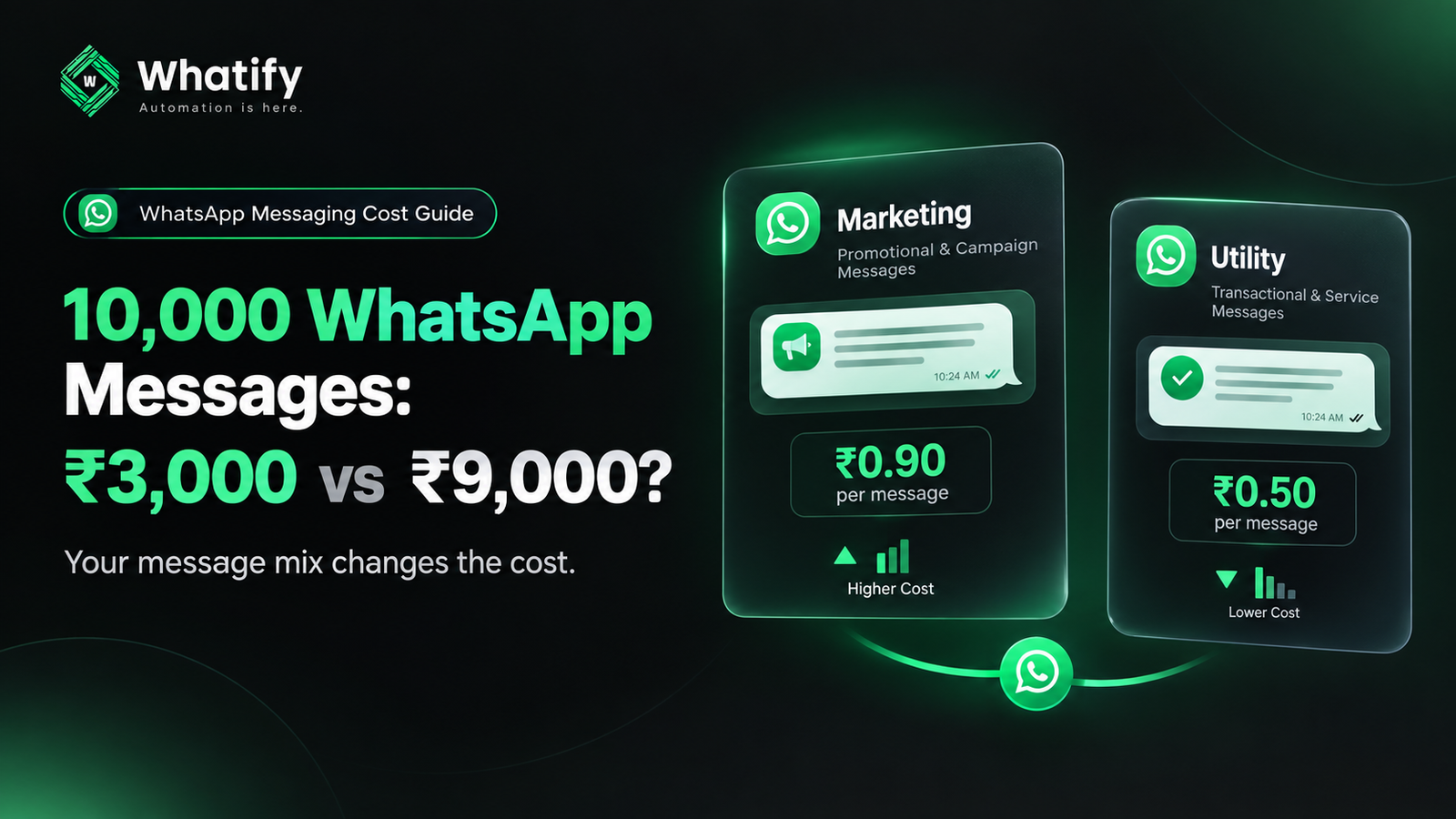
Ten thousand WhatsApp messages can cost roughly ₹3,000 or roughly ₹9,000 in message charges alone. The volume is identical. The difference is message mix — how much of that volume is marketing versus utility — plus your platform plan and GST.
This article works through four realistic scenarios using Whatify's published wallet rates, then gives you a formula to run your own numbers.
The inputs you need
Three things determine the bill:
|
Input |
Where it comes from |
|
Message volume by category |
Your campaign plan and transactional flows |
|
Per-message rate by category |
Your provider's published rate card |
|
Platform plan fee |
Your subscription tier |
Whatify's published wallet rates are ₹0.90 marketing, ₹0.50 utility and ₹0.30 authentication, excluding GST, with plans at Free ₹0, Starter ₹999, Growth ₹2,999 and Pro ₹9,999 per month. All figures below use those rates and add 18% GST. Check the current rate card before finalising a budget.
Scenario 1: All marketing — the promotional blast
10,000 marketing messages, Starter plan.
|
Item |
Calculation |
Cost |
|
Starter plan |
— |
₹999 |
|
Marketing messages |
10,000 × ₹0.90 |
₹9,000 |
|
Subtotal |
|
₹9,999 |
|
GST 18% |
|
₹1,800 |
|
Total |
|
≈ ₹11,799 |
This is the most expensive way to send 10,000 messages. It is also, for many businesses, the default — because nobody built the transactional flows.
Scenario 2: All utility — the transactional store
10,000 utility messages (order and delivery updates), Starter plan.
|
Item |
Calculation |
Cost |
|
Starter plan |
— |
₹999 |
|
Utility messages |
10,000 × ₹0.50 |
₹5,000 |
|
Subtotal |
|
₹5,999 |
|
GST 18% |
|
₹1,080 |
|
Total |
|
≈ ₹7,079 |
Same volume, roughly ₹4,700 cheaper. Every message here is one the customer actively wants.
Scenario 3: A realistic D2C mix
3,000 marketing, 6,000 utility, 1,000 authentication, Growth plan.
|
Item |
Calculation |
Cost |
|
Growth plan |
— |
₹2,999 |
|
Marketing |
3,000 × ₹0.90 |
₹2,700 |
|
Utility |
6,000 × ₹0.50 |
₹3,000 |
|
Authentication |
1,000 × ₹0.30 |
₹300 |
|
Subtotal |
|
₹8,999 |
|
GST 18% |
|
₹1,620 |
|
Total |
|
≈ ₹10,619 |
Note what happened: this business sent the same 10,000 messages as Scenario 1, on a plan three times more expensive, and still paid less overall. Mix beats plan.
Scenario 4: Festive campaign month
8,000 marketing, 2,000 utility, Growth plan.
|
Item |
Calculation |
Cost |
|
Growth plan |
— |
₹2,999 |
|
Marketing |
8,000 × ₹0.90 |
₹7,200 |
|
Utility |
2,000 × ₹0.50 |
₹1,000 |
|
Subtotal |
|
₹11,199 |
|
GST 18% |
|
₹2,016 |
|
Total |
|
≈ ₹13,215 |
Festive months legitimately skew marketing-heavy. Budget for the spike rather than being surprised by it, and recharge the wallet before the campaign rather than mid-send.
The formula for your own volume
Monthly cost =
Plan fee
+ (Marketing volume × marketing rate)
+ (Utility volume × utility rate)
+ (Authentication volume × auth rate)
+ 18% GST on the total
Two practical notes. Meta charges on delivered messages, so undelivered sends to invalid numbers do not bill — which is a reason to clean your contact list rather than pad it. And from 1 October 2026, service messages and in-window utility templates become chargeable, which adds a line for support-heavy businesses; we cover that in our guide to Meta's October 2026 service message charges.
What this means for cost per outcome
Per-message cost is the wrong metric on its own. The number that matters is cost per outcome — per recovered cart, per booking, per qualified lead.
A ₹0.90 marketing message sent to 10,000 poorly targeted contacts is expensive at any rate. The same message sent to 1,500 people who abandoned a cart in the last 48 hours costs ₹1,350 and does considerably more work. Segmentation is a cost lever before it is a marketing tactic.
Three habits that lower cost per outcome:
1. Segment by recency and behaviour rather than blasting the full list.
2. Move eligible notifications into utility templates — the mechanics are covered in our guide to WhatsApp template categories and pricing.
3. Clean the contact list quarterly. Invalid numbers do not bill, but they distort your delivery and quality metrics.
Before you commit a budget
Rates change, and Meta revises pricing on fixed quarterly dates. Confirm current numbers on the Whatify pricing page and the underlying model in our breakdown of WhatsApp Business API pricing in India.
The most accurate estimate is always your own data. Start a 14-day free trial, send one real campaign, and read the wallet spend against your actual mix.
EXTERNAL SOURCES
1. Meta — Pricing on the WhatsApp Business Platform (updated 5 Aug 2026): billing on delivered template messages, category-based rates, quarterly price-change dates, volume tiers. https://developers.facebook.com/docs/whatsapp/pricing/
2. Meta — Upcoming pricing updates (updated 1 Jul 2026): 1 October 2026 service and in-window utility charges. https://developers.facebook.com/documentation/business-messaging/whatsapp/pricing/non-template-messages
3. Whatify — pricing page (plans and wallet rates used in all four scenarios). https://whatify.in/pricing
Frequently Asked Questions
It depends on message mix. Using Whatify's published rates, 10,000 marketing messages cost about ₹9,000 in message charges, while 10,000 utility messages cost about ₹5,000. Add your plan fee and 18% GST — an all-marketing send on the Starter plan totals roughly ₹11,799.
On Whatify's published wallet rates, marketing messages are ₹0.90, utility ₹0.50 and authentication ₹0.30, excluding GST. Meta sets its own per-message charge by category and country, and providers add a platform fee or markup on top, so rates differ between providers.
Meta bills on delivered template messages, so messages that fail to deliver are not charged. That said, a list full of invalid numbers hurts delivery rates and can affect your quality rating, so cleaning contacts still matters even though it does not directly reduce the bill.
It can be, but not because of the plan itself. In the scenarios above, a business on the ₹2,999 Growth plan paid less in total than a business on the ₹999 Starter plan sending the same volume, because its message mix was weighted towards cheaper utility templates. Mix affects the bill more than plan tier.
Model the month separately, since festive campaigns skew heavily towards marketing templates. Calculate marketing volume at the marketing rate, add utility volume for order and delivery updates, add the plan fee and GST, then recharge the wallet before the campaign starts so sending does not pause mid-send.
Ready to automate your WhatsApp marketing?
Start your 14-day free trial today. No credit card required.
Start Free Trial