Meta's October 2026 WhatsApp Charges: What Changes for Indian Businesses
From 1 October 2026, Meta starts charging for WhatsApp service messages and in-window utility templates. Here is what changes and how to prepare before the date.
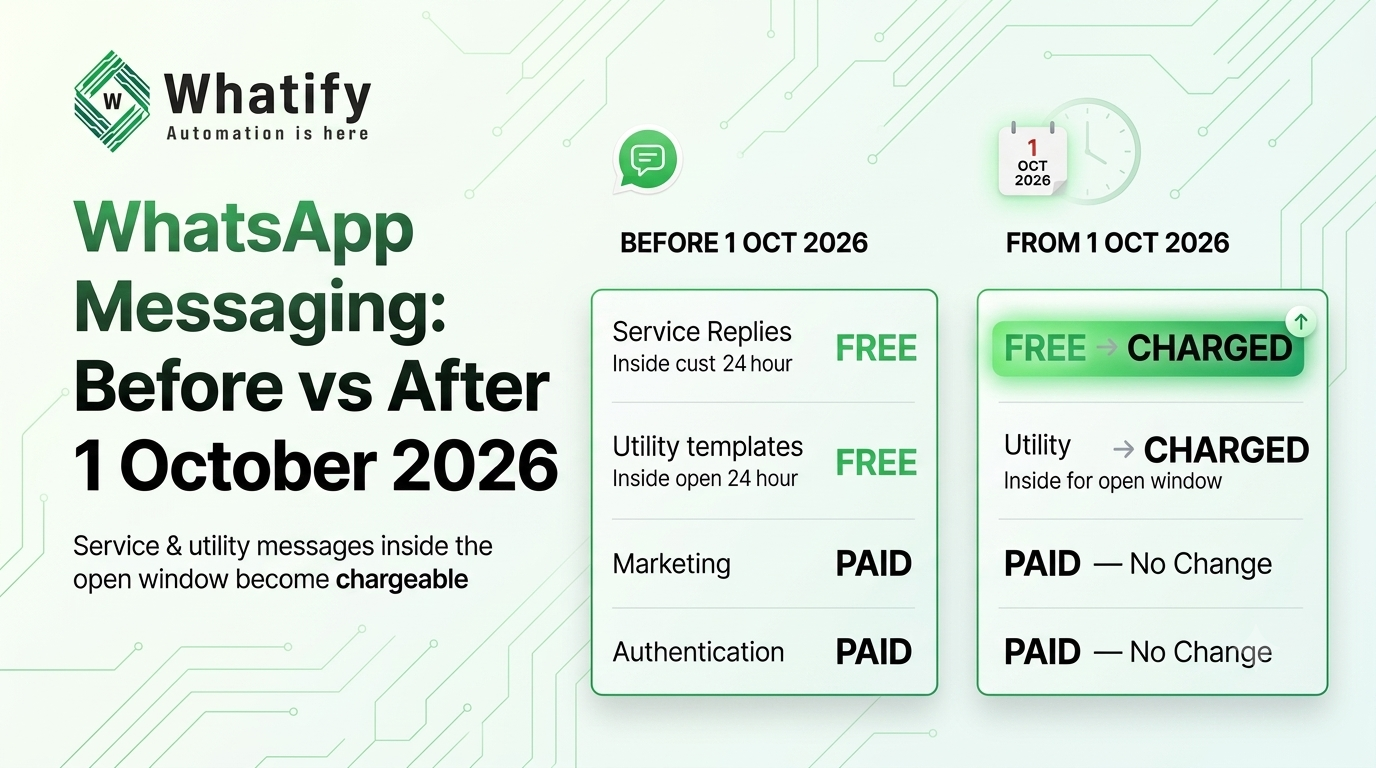
From 1 October 2026, Meta will charge for two message types that are free today: service messages sent inside the 24-hour customer service window, and utility templates sent inside that same open window. Businesses that handle a high volume of human support conversations on WhatsApp will see a cost line appear where there was none. Marketing and authentication pricing is not changing as part of this update.
Meta has confirmed the change in its developer documentation and said the applicable rates will be published by 1 September 2026. That leaves a short window to model the impact and adjust.
What is free today, and what stops being free
|
Message type |
Today |
From 1 Oct 2026 |
|
Free-form service reply inside the 24-hour window |
Free since Nov 2024 |
Charged, at utility/authentication market rates |
|
Utility template inside an open window |
Free since Jul 2025 |
Charged |
|
Utility template outside the window |
Charged |
Charged (no change) |
|
Marketing template |
Charged |
Charged (no change) |
|
Authentication template |
Charged |
Charged (no change) |
Two details matter for planning. First, Meta has stated that service messages will be priced at the same rate as utility and authentication messages in each market — so India's service rate should track India's utility rate rather than the much higher marketing rate. Second, Meta has indicated that volume tiers will not apply to service messages, which is the part large support teams should model carefully. Utility and authentication messages currently get cheaper as monthly volume climbs; if service messages sit outside that mechanism, a high-volume support operation does not earn the same discount curve.
The one thing that is easy to misread
This is not a change to the 24-hour window itself. The window still opens for 24 hours whenever a customer messages you, you can still reply freely within it, and you still do not need a template to respond. What changes is that those replies now carry a per-message cost.
Nor is it a change to the free entry-point window. Conversations that begin from a click-to-WhatsApp ad or a Facebook Page call-to-action have their own free-messaging period under Meta's entry-point rules, which is documented separately.
A separate change already in effect
From 1 August 2026, Meta began charging for Meta Business Agent messages on a per-token basis rather than per message. If you use Meta's own AI agent product, that is billed on token consumption and is not covered by the free entry-point window. This is distinct from your BSP's chatbot: a flow you build in a platform like Whatify's visual builder is not a Meta Business Agent and is not billed on tokens.
What this costs a real support team
The honest answer is that nobody can calculate it precisely until Meta publishes the rates on 1 September. What you can do now is measure your exposure.
Pull last month's numbers and count:
1. Service messages sent — every free-form reply your agents sent inside an open window.
2. Utility templates sent inside an open window — these were free and will not be.
3. Average messages per resolved conversation — this is the multiplier that decides whether the change is a rounding error or a real line item.
A team resolving 2,000 conversations a month at 6 agent replies each is looking at roughly 12,000 newly chargeable messages. At any plausible utility-linked rate, that is a number worth putting in a budget rather than discovering on an invoice.
Four things to do before 1 October
1. Measure your service-message volume this month. You cannot manage what you have not counted. Whatify's analytics and reporting show message volumes by type, which is the baseline you need.
2. Cut the repetitive replies a bot should be handling. Order status, store timings, pricing, return policy and "has it shipped" questions are the bulk of most Indian support inboxes. Every one of those deflected by an automated flow is a message you do not pay for. Our guide to building a WhatsApp chatbot without coding covers the setup.
3. Tighten agent reply habits. Three short messages cost three times one clear message. Train agents to answer completely in one reply rather than typing in fragments — a habit that also reads better to customers.
4. Re-forecast Q4 with a range, not a number. Model a low and a high case against your current utility rate until Meta publishes the actual figures in September. Then replace the estimate.
Does this change whether WhatsApp is worth it?
For most Indian businesses, no. Service messaging moves from free to cheap, not from free to expensive — it is being priced at utility-tier levels, which remain among the lowest rates on the platform. The businesses that will feel it are those using WhatsApp as a high-touch human support channel with long back-and-forth threads, and for them the fix is the same thing that improves response times anyway: automate the repetitive layer and let agents handle the exceptions.
If you are budgeting from scratch, the full cost structure — Meta charges, platform fees and GST — is broken down in our guide to WhatsApp Business API pricing in India. And if you want to see your own message mix before the change lands, start a 14-day free trial and check the analytics on your real traffic.
Verify before you budget
Meta reserves pricing changes for 1 January, 1 April, 1 July and 1 October each year, and publishes rate cards in its developer documentation. Before you finalise Q4 numbers, check Meta's pricing updates documentation for the rates due by 1 September 2026.
EXTERNAL SOURCES
1. Meta — Upcoming pricing updates: Meta Business Agent, service and utility messages (updated 1 Jul 2026): the 1 October 2026 change, service messages priced at utility/authentication market rates, no volume tiers for service messages, rates to be published by 1 September 2026, 1 August 2026 per-token Meta Business Agent billing. https://developers.facebook.com/documentation/business-messaging/whatsapp/pricing/non-template-messages
2. Meta — Pricing on the WhatsApp Business Platform (updated 5 Aug 2026): customer service window mechanics, quarterly price-change dates, volume tiers for utility and authentication. https://developers.facebook.com/docs/whatsapp/pricing/
3. Whatify — features page (analytics and reporting capability). https://whatify.in/features
Frequently Asked Questions
Two things become chargeable. Free-form service messages sent inside the 24-hour customer service window, which have been free since November 2024, and utility templates sent inside an open window, which have been free since July 2025. Marketing and authentication pricing is unchanged.
Meta has said service messages will be charged at the same rate as utility and authentication messages in each market, but it had not published the specific rates at the time of writing. Meta committed to publishing them by 1 September 2026, so confirm the final figures in Meta's developer documentation before setting a budget.
No. The window works exactly as before — it opens for 24 hours each time a customer messages your business, and you can still reply without a template inside it. The only change is that those replies will carry a per-message charge from 1 October 2026.
Meta has indicated that volume tiers will not apply to service messages, unlike utility and authentication messages, which get cheaper at higher monthly volumes. High-volume support teams should model costs without assuming a discount curve until Meta confirms otherwise.
Entry-point conversations are governed by separate rules in Meta's documentation and are not the subject of this change. Meta's per-token charge for Meta Business Agent messages, effective 1 August 2026, is explicitly not covered by the free entry-point window.
Automate repetitive queries such as order status and store timings so a bot resolves them instead of an agent, train agents to reply in one complete message rather than several fragments, and measure your current service-message volume now so you can forecast accurately once Meta publishes the rates.
Ready to automate your WhatsApp marketing?
Start your 14-day free trial today. No credit card required.
Start Free Trial