Interakt Alternatives 2026: 4 Best WhatsApp API Platforms for E-commerce
Interakt markets itself as budget-friendly, but its markups add up fast. Compare 4 WhatsApp API alternatives for e-commerce stores — pricing and fit for 2026.
Interakt's "Budget-Friendly" Claim, Tested
Interakt has built its marketing around being the affordable, no-fuss entry point into WhatsApp Business API for Indian D2C brands. It's a fair pitch for a store just getting started—unlimited team members, basic automation, and a quick Shopify sync are useful in month one.
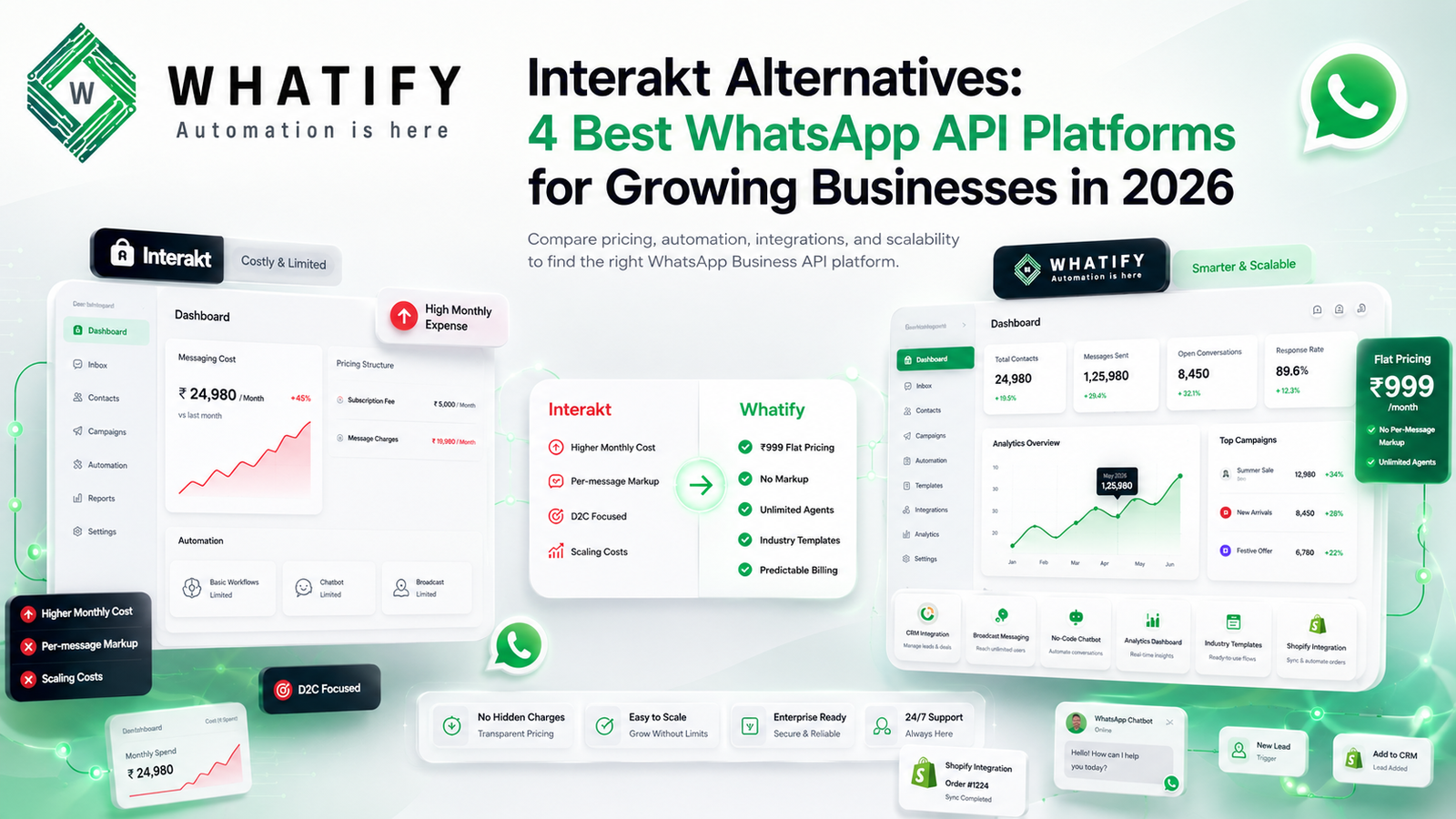
But "budget-friendly" only holds up if you stop at the headline number. Interakt's pricing runs on two layers: a subscription fee (monthly, quarterly, or annual) plus variable per-message charges that carry a markup over Meta's base rate. Independently reported analysis found that on the Growth plan, Interakt charged roughly ₹0.871 per marketing conversation against Meta's own documented rate of about ₹0.695—a markup of around 25%. At 100,000 monthly messages, that gap alone can add well over ₹17,000 to a bill that started at ₹2,499.
Compare that to Whatify's starter price of ₹999/month, flat, with no per-message markup layered on top. For a store sending the same volume, the gap between "what the pricing page says" and "what you actually pay" simply doesn't exist with a flat wallet model.
Where the ₹999 vs ₹2,499 Comparison Actually Comes From
Interakt's entry-level Starter plan on quarterly billing works out to roughly ₹1,166/month, and even that tier restricts you to a single channel (WhatsApp OR Instagram, not both) with limited automation. To get the features most e-commerce stores actually need—both channels, branched chatbots, COD-to-prepaid conversion tools—brands typically move up to Interakt's Growth plan, which independently reported pricing places around ₹2,499/month on monthly billing.
Whatify's ₹999/month starter, by contrast, includes unlimited agent access and flat-rate messaging without a separate CRM subscription requirement. For a growing store, that's not just a lower number—it's a lower number that stays predictable as your team and message volume grow.
Template Coverage: The Overlooked Difference
One factor that rarely shows up in pricing comparisons is template breadth. Interakt's built-in templates lean heavily toward e-commerce and D2C use cases—cart recovery, order updates, COD confirmation. That's fine if you're a fashion or FMCG brand, but real estate, EdTech, and services businesses often find themselves building templates from scratch or waiting on custom approvals.
Whatify ships with industry-specific template libraries spanning e-commerce, real estate, EdTech, and retail verticals, which shortens the time between signup and your first live campaign—especially useful if your catalog spans more than one vertical.
What to Look for in an Interakt Alternative
Before switching platforms, e-commerce teams should weigh:
-
Pricing transparency: Is the markup on Meta's rate disclosed upfront, or buried in fine print?
-
Agent limits: Do you pay per seat, or is your team unlimited?
-
Template breadth: Does the platform cover your specific vertical, or only generic e-commerce flows?
-
Integration depth: Shopify/WooCommerce integration depth—cart recovery, order sync, and catalog tools out of the box.
-
Total cost of ownership (TCO): Calculated at your actual message volume, not the sticker price.
4 Interakt Alternatives Compared
1. Whatify
Flat wallet pricing starting at ₹999/month—no per-message markup, no per-agent fees, unlimited agents from the base plan. Broader template coverage across e-commerce, real estate, EdTech, and retail means less time spent building campaigns from scratch.
-
Best for: Stores that want Interakt's low entry price without the markup that shows up later.
2. Wati
A mature, India-focused BSP with strong CRM integrations (HubSpot, Salesforce, Zoho) and a Shopify plugin. Independently reported pricing shows Wati layers a subscription fee, a documented markup on Meta's per-message rates (commonly cited around 20%), and per-seat charges once you exceed included users.
-
Best for: Teams that already run on Zoho or Salesforce and want deep CRM sync.
3. AiSensy
One of the lowest-cost entry points, with a free-forever tier and Basic plans starting near ₹1,500/month, billed separately from Meta's per-message rates. Chatbot and broadcast scheduling are typically gated to higher tiers.
-
Best for: Early-stage stores testing WhatsApp before committing to a full-featured platform.
4. DoubleTick
A mobile-first, WhatsApp-like interface aimed at field sales and chatbot-heavy teams, typically sold on annual commitments. Reported pricing runs higher than several competitors on a per-seat basis, with extra-agent fees stacking quickly for larger teams.
-
Best for: Businesses whose sales reps work primarily from mobile devices.
Objection: "Isn't Switching WhatsApp Providers Risky?"
It's a fair concern—your WhatsApp number and customer relationship live on that account, and nobody wants downtime during an active sales campaign. In practice, migration is more mechanical than risky:
-
Your WhatsApp Business Account (WABA) and phone number transfer with you; you're not starting over with a new number.
-
Existing message templates need re-approval under the new provider, which typically takes a few business days if templates already follow Meta's approved format.
-
Most providers, including Whatify, offer migration support to reconnect Shopify or WooCommerce integrations without losing historical order data.
The bigger risk, for most growing stores, is staying on a pricing model where the markup compounds every time a campaign scales—not the short migration window itself.
A Quick Scenario
Consider a mid-sized D2C fashion brand sending roughly 40,000 marketing messages a month during a festive sale. On Interakt's Growth plan, the ₹2,499 subscription plus a 25% markup on Meta's per-message rate can push the effective monthly spend well past ₹35,000 once volume-driven charges are added. On Whatify's flat wallet model, that same volume is billed against the wallet balance without an additional markup layer—meaning the number on the invoice matches the number the team budgeted for at the start of the month.
Making the Switch
Migrating off Interakt typically involves porting your WABA, re-approving existing templates with the new provider, and reconnecting your storefront integration. Most e-commerce brands complete this within a few business days when templates are already Meta-approved.
Platform Comparison Table
| Platform | Starting Price | Per-Message Markup | Agent Limits | Template Coverage | Best For |
| Whatify | ₹999/mo flat | None | Unlimited | Broad (e-commerce, real estate, EdTech, retail) | Cost-predictable scaling |
| Interakt | ₹2,499/mo (Growth) | ~25% (documented) | Unlimited (marketing plans) | E-commerce/D2C focused | Starter D2C brands |
| Wati | From ₹2,499/mo | ~20% (reported) | Capped, per-seat fees | Broad, CRM-linked | CRM-heavy teams |
| AiSensy | From ₹1,500/mo | Minimal/none reported | 5 free, then per-seat | Moderate | Budget entry |
| DoubleTick | ₹2,000–₹8,300+/mo | Meta pass-through + fees | 5–10 included, per-seat after | Chatbot-focused | Mobile-first sales teams |
Figures reflect independently reported and publicly documented pricing as of 2026; confirm current rates directly with each vendor before purchasing.
Conclusion
Interakt's "budget-friendly" positioning holds up at the entry tier, but the documented markup on Meta's per-message rates and the jump to Growth-plan pricing tell a different story at scale. Whatify's flat ₹999/month wallet pricing, unlimited agents, and broader template coverage make it the more predictable choice for e-commerce stores planning to grow message volume—while Wati, AiSensy, and DoubleTick each serve more specific priorities like CRM depth, rock-bottom entry cost, or mobile-first sales.
Frequently Asked Questions
Whatify is a strong fit for Shopify merchants — its flat ₹999/month wallet pricing avoids the per-message markup that inflates Interakt bills at scale, while still covering cart recovery and order-update automation.
Not necessarily. Interakt's starter tier looks affordable, but reaching feature parity with e-commerce alternatives usually means moving to its Growth plan (~₹2,499/month) plus a documented markup on per-message costs — often landing higher than flat-rate competitors like Whatify.
Meta's underlying conversation charges apply across all official WhatsApp Business Solution Providers. The difference between platforms is whether they add their own markup on top of Meta's rate.
It matters more as you scale support during sales events. Platforms that charge per agent can make seasonal hiring expensive, while unlimited-agent models like Whatify's keep costs flat regardless of team size.
Most migrations take a few business days if your WhatsApp Business Account and templates are already Meta-approved, since templates need re-approval under the new provider.
Ready to automate your WhatsApp marketing?
Start your 14-day free trial today. No credit card required.
Start Free Trial