Best Bulk WhatsApp Sender for Small Business in India
Compare the best bulk WhatsApp senders for Indian SMBs in 2026 — pricing, compliance, and features of Whatify, Wati, AiSensy, Interakt & DoubleTick.
Why "Bulk WhatsApp Sender" Is the Wrong Search — And the Right Fix
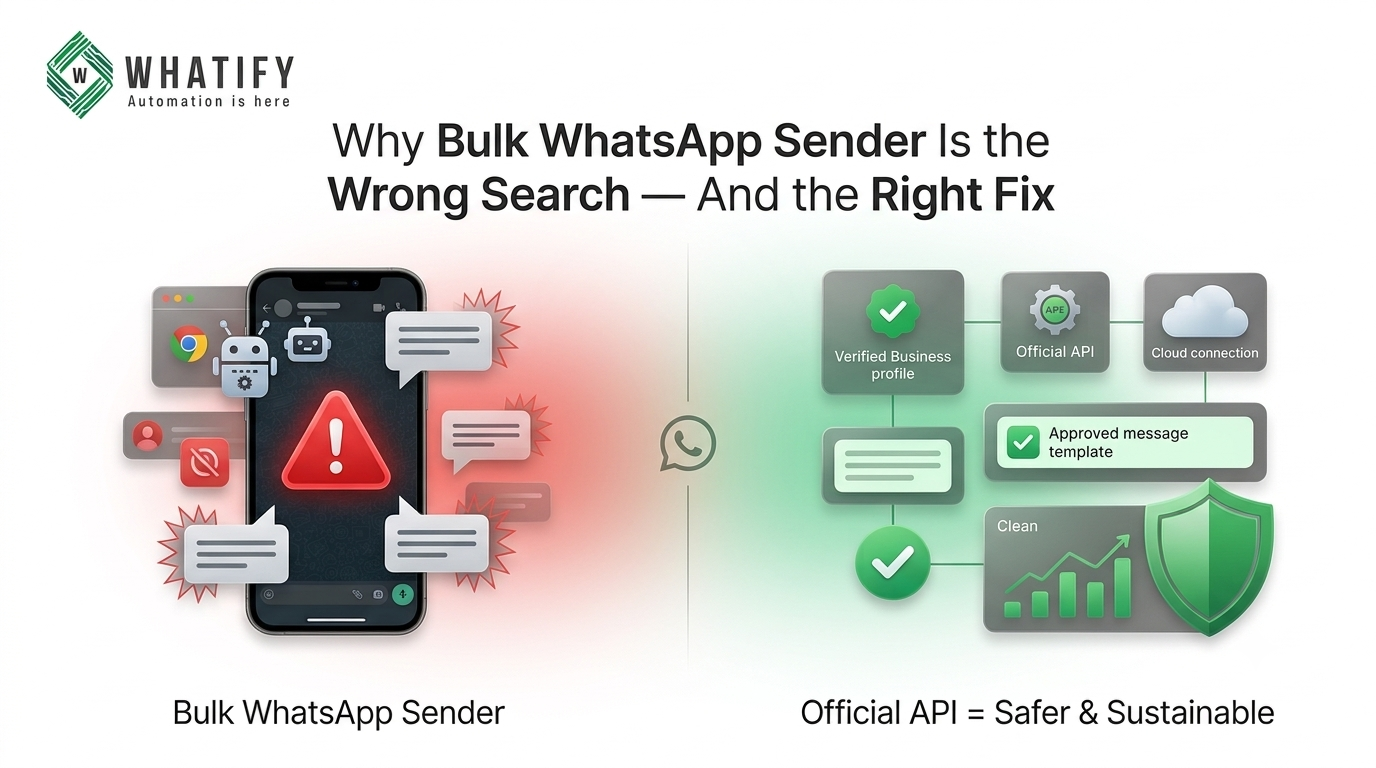
If you've searched for a "bulk WhatsApp sender," you've probably landed on tools promising to blast thousands of messages from your personal number — no API, no template approval, no setup fees. It's a tempting pitch for a small business trying to save money. It's also the fastest way to lose your WhatsApp number permanently.
Here's the distinction that matters: WhatsApp draws a hard line between unofficial automation (browser extensions, modded APKs, WhatsApp Web bots) and the official WhatsApp Business API, run through a Meta-verified Business Solution Provider (BSP) like Whatify. Only the second path is legal, compliant, and sustainable for a growing business.
This guide breaks down what makes a bulk WhatsApp sender genuinely safe to use, what Indian compliance actually requires, and how the top BSPs — Whatify, Wati, AiSensy, Interakt, and DoubleTick — compare on price and features for small businesses in 2026.
Is Bulk WhatsApp Messaging Legal in India?
Yes — with conditions. Bulk WhatsApp messaging is legal in India when it's sent through the official WhatsApp Business API, to contacts who have given clear, recorded opt-in consent, using Meta-approved message templates.
What makes it illegal — or at least dangerous — is the method, not the volume. Sending 10,000 messages through the official API to an opted-in list is standard practice for thousands of Indian SMBs. Sending the same 10,000 messages through an unofficial "sender" tool, or to a purchased contact list, breaks both Meta's Terms of Service and India's data protection law.
Three things determine whether your bulk sending is compliant:
1. The channel — Official WhatsApp Business API via a verified BSP, not a browser extension or modded app.
2. Consent — Every recipient must have taken an affirmative opt-in action (a checkbox, a keyword reply, a signup form). Pre-ticked boxes and assumed consent don't count.
3. The message type — Outside a live 24-hour conversation window, every message must use a template that Meta has reviewed and approved, correctly categorized as marketing, utility, or authentication.
Why Unofficial Bulk Senders Get Numbers Banned
Unofficial tools work by automating your personal WhatsApp or WhatsApp Business App — essentially tricking the app into sending messages faster than a human could. Meta's systems are built to catch exactly this kind of behavior through pattern detection: identical messages going to hundreds of recipients, unnatural send speed, and spikes in user reports.
The consequences compound quickly:
- Permanent number ban — not a suspension, a full loss of that number on WhatsApp
- No delivery tracking or analytics — you're sending blind
- No structured opt-out handling — a direct compliance gap under the DPDP Act
- Zero recourse — appeals for unofficial-tool bans are rarely successful
For a small business, losing your customer-facing WhatsApp number isn't a minor setback — it means rebuilding trust, re-collecting contacts, and starting your quality rating from zero.
What India's Compliance Rules Actually Require
Two frameworks govern bulk WhatsApp sending for Indian businesses:
Meta's WhatsApp Business Messaging Policy requires verified BSP access, Meta-approved templates for any message outside the 24-hour service window, and adherence to messaging category rules (marketing vs. utility vs. authentication).
India's Digital Personal Data Protection Act (DPDP), 2023 requires explicit, revocable consent before you collect or use a customer's phone number, clear notice of what you'll send and why, an easy one-tap way to withdraw consent, and auditable consent records (timestamp, source, and method).
A quick note on DLT: some vendor content claims WhatsApp bulk sending requires DLT registration (the system TRAI built for SMS and voice). The more consistent read across current sources is that DLT does not apply to WhatsApp, since it's an OTT service governed separately by Meta and the DPDP Act — but this is genuinely unsettled territory with mixed claims online, so it's worth a direct check with your compliance advisor before you scale, rather than relying on any single blog's interpretation.
What to Look for in a Bulk WhatsApp Sender for Small Business
Not every official BSP is built the same way. For a small business specifically, four things matter most:
1. Transparent, flat pricing. Many platforms advertise a low base price, then add a markup on top of Meta's per-conversation rate — sometimes 20% or more. At scale, that markup can add thousands of rupees a month. A flat "wallet" model, where you pay Meta's rate with no BSP markup layered in, is far more predictable.
2. No per-agent fees. If your team grows — even by one or two people — a platform that charges per seat gets expensive fast. Unlimited agents on every plan removes that friction entirely.
3. Built-in compliance tooling. Opt-in capture, one-tap opt-out, consent logging, and quality-rating monitoring should be part of the platform, not a manual workaround.
4. A genuine free trial. You want to test broadcast speed, template approval turnaround, and support responsiveness before committing — ideally for a full 14 days, not a capped credit trial.
Whatify vs. Wati vs. AiSensy vs. Interakt vs. DoubleTick: 2026 Comparison
|
Platform |
Starting Price |
Pricing Model |
Agents |
Free Trial |
Best For |
|
Whatify |
₹999/month |
Flat wallet pricing, no per-message markup |
Unlimited on every plan |
14 days |
SMBs wanting predictable, low TCO bulk sending |
|
Wati |
~₹1,999–2,499/month |
Reported markup on Meta rates (varies by category) |
Limited on entry tiers |
Yes (duration varies) |
Teams wanting deep CRM integrations |
|
AiSensy |
~₹1,500/month |
Per-message markup varies by plan |
Limited unless on higher tiers |
Free forever tier + 14-day Pro trial |
Broadcast-heavy campaigns, Click-to-WhatsApp ads |
|
Interakt |
~2499/month |
Per-conversation pricing, quarterly billing |
Varies by tier |
Yes (duration varies) |
Shopify D2C brands needing native cart recovery |
|
DoubleTick |
~2000-3000/month |
Subscription + separate Meta conversation charges |
5–10 seats included, extra agents cost more |
Limited |
Field sales teams needing a mobile-first app |
Note: competitor pricing changes frequently and is compiled from third-party comparison sources rather than official vendor rate cards — confirm current figures directly on each platform's pricing page, especially before quoting numbers in paid campaigns.
Where Whatify wins for small businesses: no per-message markup eating into your margin as you scale, no per-agent fees as your support or sales team grows, and a lower, more transparent entry price than most of the field. For a small business sending a few thousand bulk messages a month, that combination of flat pricing and unlimited seats typically works out cheaper than Wati, Interakt, or DoubleTick — and more predictable than markup-based models.
Getting Started: A Practical Checklist
1. Choose a Meta-verified BSP — confirm official WhatsApp Business API access, not a reseller workaround.
2. Complete Meta Business Verification for your business account.
3. Build your opted-in contact list — never import purchased or scraped numbers.
4. Submit templates for approval, categorized correctly as marketing, utility, or authentication.
5. Segment your audience before broadcasting — one message doesn't fit every customer stage.
6. Include a clear opt-out in every marketing template.
7. Monitor your quality rating and pause campaigns if it drops.
8. Comparison Table
(Included above in Section 7 for contextual placement — repeated here per format for reference.)
|
Platform |
Starting Price |
Pricing Model |
Agents |
Free Trial |
|
Whatify |
₹999/month |
Flat wallet, no markup |
Unlimited |
14 days |
|
Wati |
~₹1,999–2,499/month |
Markup on Meta rates |
Limited |
Yes |
|
AiSensy |
~₹999–1,500/month |
Markup varies |
Limited on lower tiers |
Free tier + 14-day trial |
|
Interakt |
~₹2,499/month |
Per-conversation |
Varies |
Yes |
|
DoubleTick |
~₹2000-3000/month |
Subscription + Meta charges |
5–10 seats |
Limited |
Conclusion
For Indian small businesses, "bulk WhatsApp sender" should mean one thing: the official WhatsApp Business API, accessed through a verified BSP. It's the only route that's both legal and sustainable — unofficial tools might look cheaper today, but a banned number costs far more in lost trust and rebuilding time. Once you're on the compliant path, the platform you choose still matters. Whatify's flat wallet pricing, unlimited agents, and 14-day free trial are built specifically for small businesses that want predictable costs as their WhatsApp campaigns scale — without the markup surprises common across the category.
Frequently Asked Questions
Yes. It's legal when you use the official WhatsApp Business API, send messages only to users who have opted in, and use Meta-approved templates.
Very rarely. If you follow Meta's rules, use approved templates, and message only opted-in users, your account is generally safe.
The Business App is for small businesses with basic messaging. The Business API supports bulk messaging, automation, analytics, and multi-user access for growing businesses.
Using unofficial tools can lead to permanent number bans, poor message delivery, and compliance risks. The official WhatsApp Business API is the safer and more reliable choice.
Costs usually include Meta's conversation charges and your provider's platform fee. Plans typically start from ₹999/month, depending on the provider.
Ready to automate your WhatsApp marketing?
Start your 14-day free trial today. No credit card required.
Start Free Trial