WhatsApp Automation for E-commerce: Cut Cart Abandonment by 35%
Discover how WhatsApp automation helps Indian e-commerce stores recover abandoned carts, reduce RTO losses, confirm orders, and increase sales with smart automated customer engagement.
WhatsApp Automation for E-commerce: How to Cut Cart Abandonment by 35%
You've run the ads. You've got the clicks. Your product page looks great. And still — nearly 7 out of 10 shoppers leave without buying.
Cart abandonment is the silent revenue killer in Indian e-commerce. And while most brands keep throwing money at retargeting ads, the smarter ones have found a different channel: WhatsApp automation for e-commerce.
This isn't just about sending a nudge. Done right, WhatsApp automation covers the entire post-visit journey — from cart recovery to order confirmation, COD verification to delivery updates — turning one-time visitors into loyal customers.
Let's break down how it works, what flows to build, and how platforms like Whatify make it possible without a tech team.
1.Why Cart Abandonment Is Worse in India Than You Think
India's e-commerce market crossed ₹4.4 lakh crore in 2023, yet the average cart abandonment rate sits at 72–78% across categories. That number gets even higher on mobile — where over 70% of Indian shoppers browse and buy.
The reasons are familiar:
-
Unexpected shipping costs revealed at checkout
-
Forced account creation
-
Distraction mid-session
-
Payment failures
-
"Let me think about it" moments that never convert
The window to win them back is narrow. Over 60% of recoverable shoppers decide within 1 hour of abandonment. Email won't reach them in time. Push notifications get blocked. WhatsApp does neither.
2.How WhatsApp Automation for E-commerce Works
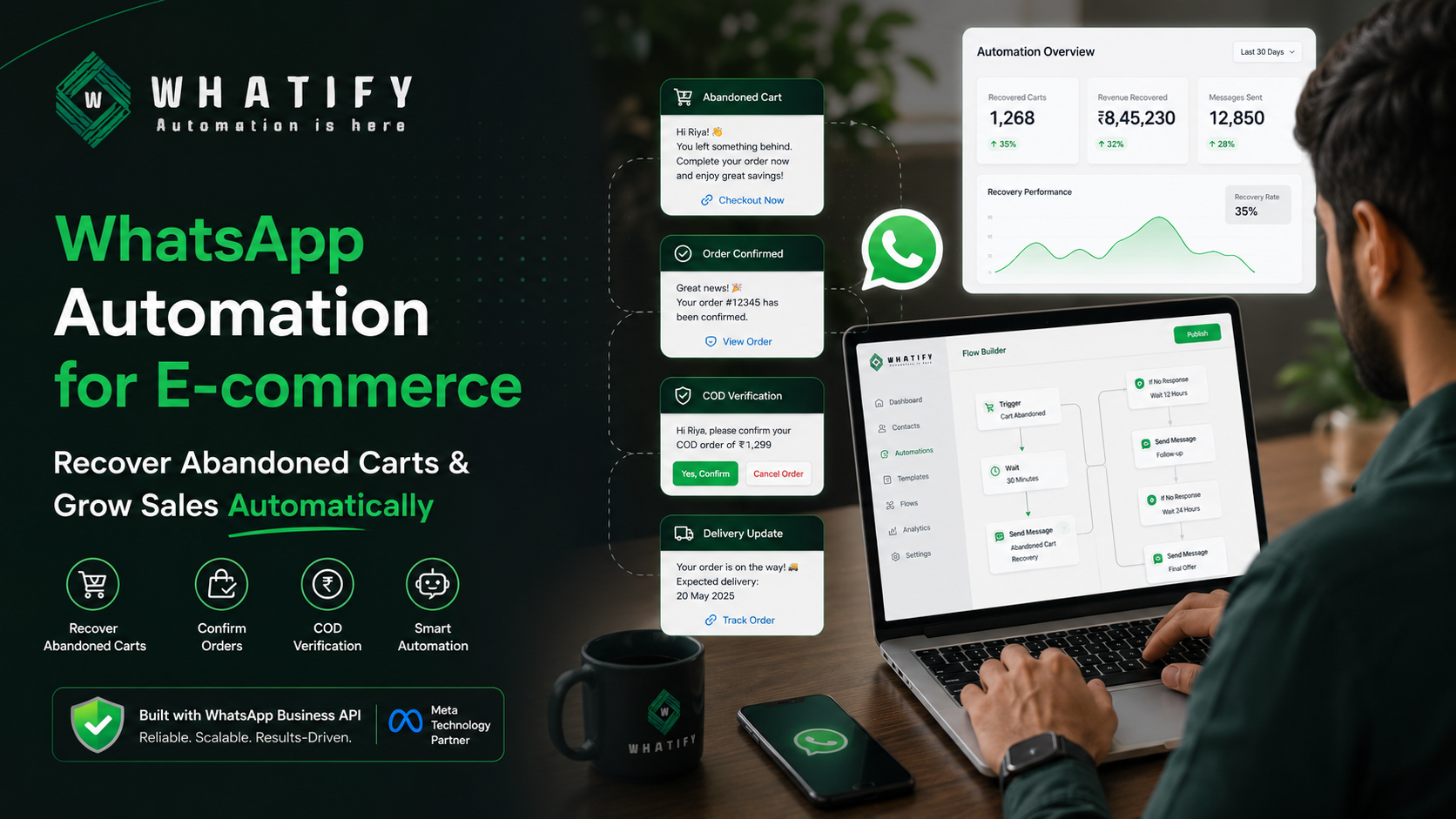
WhatsApp Business API allows brands to connect their e-commerce platforms (Shopify, WooCommerce, Magento, custom stacks) to automated messaging workflows. When a predefined event occurs — cart abandoned, order placed, payment failed — a message is triggered automatically, without any manual intervention.
Here's the basic architecture:
Customer Action → Trigger Event → WhatsApp API → Automated Message Sent
The messages are:
-
Template-based (approved by Meta for business use)
-
Personalised with customer name, product name, cart value, and images
-
Sent within seconds of the trigger firing
Platforms like Whatify provide a no-code flow builder where you can map out these sequences visually, connect your store, and go live — no developer required.
3.The 4 Core WhatsApp Automation Flows Every E-commerce Brand Needs
i. WhatsApp Abandoned Cart Recovery
This is the highest-ROI automation you can build.
How it works:
-
Customer adds items to cart but doesn't complete payment
-
After 30–60 minutes, an automated WhatsApp message is sent with the cart summary
-
If no action, a follow-up is triggered at 12 hours with a mild nudge
-
At 24 hours, a final message goes out — optionally with a limited-time offer
Sample Sequence:
|
Message No. |
Timing |
Tone |
Optional Incentive |
|---|---|---|---|
|
1st |
30–60 mins |
Helpful reminder |
None |
|
2nd |
12 hours |
Soft urgency |
Free shipping |
|
3rd |
24 hours |
Final nudge |
5–10% discount |
What to include in Message 1:
-
Customer's first name
-
Product image + name
-
Cart value
-
Direct checkout link
-
A human, non-salesy tone
"Hi Priya, you left something behind! Your [Product Name] is still waiting in your cart. Complete your order here: [Link]"
WhatsApp abandoned cart recovery messages typically achieve 25–35% click-through rates — compared to 3–5% for equivalent email sequences.
ii. WhatsApp Order Confirmation Automation
The moment a customer places an order, they want confirmation. Instantly.
WhatsApp order confirmation automation sends a rich, personalised message the second the order is processed — covering:
-
Order ID and summary
-
Estimated delivery date
-
Payment mode confirmation
-
Customer support link
This isn't just good experience. It reduces WISMO (Where Is My Order) support tickets by 30–40% — a significant cost saving for growing D2C brands.
What a strong order confirmation message includes:
-
Order number
-
Items ordered (with image if applicable)
-
Delivery address confirmation
-
Expected delivery window
-
Live tracking link (once available)
-
Easy return/exchange CTA
iii. WhatsApp COD Verification
Cash-on-Delivery still accounts for over 50% of orders in Tier 2 and Tier 3 Indian cities. The problem? COD orders have RTO rates as high as 30–40%. Customers cancel, refuse delivery, or simply aren't available.
WhatsApp COD verification changes this completely.
The Flow:
-
Order placed with COD
-
Automated WhatsApp message sent within 5 minutes
-
Customer confirms intent with a single tap (Yes/No buttons)
-
Unconfirmed orders are either cancelled or flagged for a call
This single automation can reduce RTO losses by 30–45%, which directly improves logistics costs and unit economics.
Sample COD Verification Message:
"Hi Rahul, we've received your order for [Product] worth ₹1,299 (Cash on Delivery). Please confirm you'd like to proceed.
👍 Yes, confirm my order
❌ Cancel order"*
Interactive reply buttons make this frictionless for the customer and clean for your operations team.
iv. Delivery Update & Post-Purchase Flows
Customer retention starts after the first order — not before it.
Automated WhatsApp sequences after delivery can include:
-
Shipping dispatched notification
-
Out-for-delivery alert
-
Delivery confirmation message
-
Review/rating request (sent 2–3 days post-delivery)
-
Cross-sell or reorder reminder (sent 7–14 days later based on product type)
This turns a transactional relationship into an ongoing conversation — and repeat customers spend 67% more than first-time buyers.
4.WhatsApp Automation vs. Other Recovery Channels
|
Feature |
|
|
SMS |
Push Notifications |
|---|---|---|---|---|
|
Average Open Rate |
90–95% |
20–25% |
30–35% |
5–10% |
|
Click-Through Rate |
25–35% |
2–5% |
8–12% |
2–4% |
|
Personalisation |
Rich (image, CTA, name) |
Moderate |
Limited |
Limited |
|
Two-Way Interaction |
Yes |
No |
No |
No |
|
COD Verification |
Yes (buttons) |
No |
Basic |
No |
|
Cost in India |
Low–Medium |
Low |
Medium |
Low |
|
Customer Preference |
Very High |
Moderate |
Low |
Low |
The numbers make the case clearly. WhatsApp automation for e-commerce isn't an experiment — it's a competitive necessity.
5.Setting Up WhatsApp Automation with Whatify
Whatify is a WhatsApp Business API platform built specifically for Indian businesses. It offers:
-
No-code automation builder — drag-and-drop flows for cart recovery, COD verification, order updates
-
Shopify & WooCommerce integration — connects in minutes, no developer needed
-
Pre-approved message templates — Meta-compliant templates ready to deploy
-
Broadcast campaigns — for promotional offers alongside transactional flows
-
Team inbox — handle customer replies without switching tools
-
Analytics dashboard — track open rates, click rates, and revenue recovered
For a D2C brand doing 500–5,000 orders per month, the setup time is typically under 2 hours. The ROI often shows within the first week.
6.Real-World Use Cases by Category
1.Fashion & Apparel
High cart abandonment driven by size uncertainty. Solution: Automated WhatsApp message with size guide link + review of that exact product from verified buyers.
2.Beauty & Personal Care
Repeat purchase cycles are short (30–60 days). Post-purchase WhatsApp flows with reorder reminders timed to product usage cycles drive strong repeat rates.
3.Electronics & Gadgets
High-value carts = high abandonment anxiety. WhatsApp recovery message with warranty details, easy return policy, and EMI options addresses objections directly.
4.EdTech & Courses
Not e-commerce in the traditional sense, but the same flows apply. Cart abandonment for course enrolments is a massive problem — WhatsApp recovery with a demo class link or limited seat urgency converts well.
Common Mistakes to Avoid
-
Sending too many messages — Three messages per cart event maximum. Beyond that, you risk being blocked.
-
Generic, impersonal copy — Always use the customer's name and exact product details.
-
No opt-out option — WhatsApp Business API requires opt-in. Build compliant flows from day one.
-
Ignoring replies — If a customer replies, they expect a response. Use a team inbox or chatbot to handle inbound messages.
-
Skipping COD verification — If you're shipping COD and not verifying, you're leaving RTO losses on the table.
7.Comparison Table
WhatsApp Automation Platform Comparison (India)
|
Platform |
No-Code Builder |
Shopify Integration |
COD Verification |
Starting Price |
Best For |
|---|---|---|---|---|---|
|
Whatify |
✅ Yes |
✅ Yes |
✅ Yes |
999/mo |
D2C, SMBs, growing brands |
|
Wati |
✅ Yes |
✅ Yes |
Partial |
2199/mo |
Small teams |
|
AiSensy |
✅ Yes |
✅ Yes |
❌ Limited |
₹1500/mo |
Beginners |
|
Interakt |
✅ Yes |
✅ Yes |
✅ Yes |
₹2000/mo |
Mid-market |
Conclusion
Cart abandonment isn't a customer problem — it's a communication problem. Shoppers don't vanish; they just need the right message at the right time on the right channel.
WhatsApp automation for e-commerce gives you exactly that. With recovery rates up to 35%, reduced RTO losses through COD verification, and stronger post-purchase retention via order update flows, the business case is undeniable.
The brands winning in Indian e-commerce right now aren't necessarily the ones with the biggest ad budgets. They're the ones building smarter customer journeys — and WhatsApp is at the centre of that strategy.
Frequently Asked Questions
WhatsApp automation for e-commerce refers to the use of the WhatsApp Business API to send automated, event-triggered messages to customers — such as abandoned cart reminders, order confirmations, COD verification requests, and delivery updates — without manual effort.
Brands using properly configured WhatsApp abandoned cart recovery sequences typically recover 20–35% of otherwise lost carts. Results vary based on message timing, copy quality, and product category, but even a 15% recovery rate on a ₹10 lakh monthly abandonment value translates to ₹1.5 lakh in recovered revenue.
Yes, provided customers have opted in to receive WhatsApp messages from your brand. The WhatsApp Business API requires explicit opt-in, and Meta's messaging policies apply. Platforms like Whatify help you build compliant opt-in flows from the start.
When a customer places a COD order, an automated WhatsApp message is sent asking them to confirm their intent using quick-reply buttons. Unverified or cancelled orders are flagged before dispatch, preventing unnecessary shipping costs and logistics returns. This typically reduces COD RTO by 30–45%.
Yes. Platforms like Whatify offer no-code flow builders with pre-built e-commerce integrations for Shopify and WooCommerce. Most brands can set up core automation flows in under 2 hours without any technical knowledge.
The WhatsApp Business App is a free mobile app for very small businesses — it's manual and cannot be automated. The WhatsApp Business API is a developer-grade solution (accessed through BSPs like Whatify) that enables automation, bulk messaging, CRM integration, and team inbox features at scale.
Ready to automate your WhatsApp marketing?
Start your 14-day free trial today. No credit card required.
Start Free Trial