WhatsApp API Pricing Compared: What to Check
Provider pricing pages are not comparable as published. A method for normalising quotes to one number, plus the six charges that hide outside the headline plan fee.
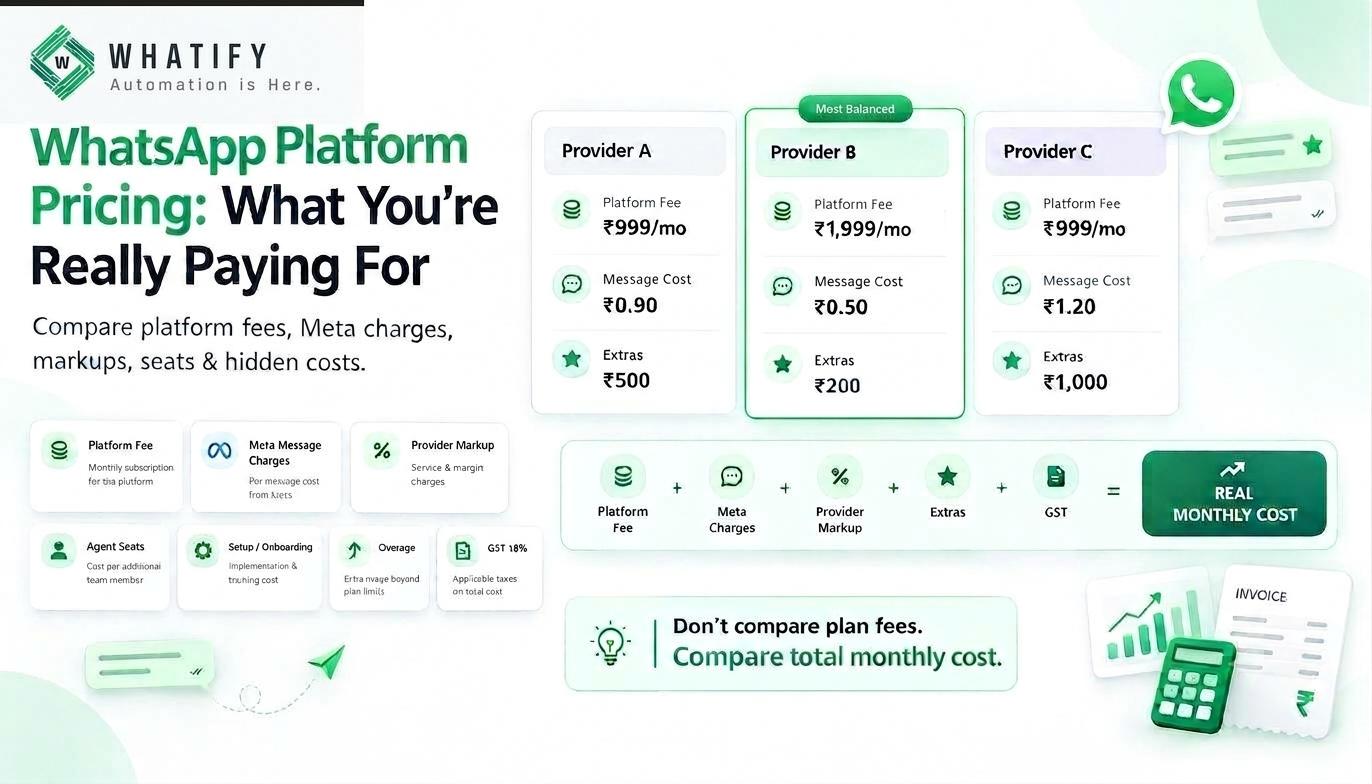
Three providers quote you a monthly price. One looks half the cost of the others. Six months later the cheap one is the most expensive thing you pay for.
This happens because WhatsApp platform pricing has at least four moving parts, and pricing pages present them differently on purpose. Here is how to reduce any quote to a single comparable number.
The four components
Every provider's bill is some combination of:
1. Platform fee — the monthly or annual subscription
2. Meta's per-message charge — set by Meta, by template category, on delivered messages
3. Provider markup on messages — an addition on top of Meta's rate, if any
4. Extras — setup, onboarding, agent seats, add-on modules, overage
Only component 2 is genuinely fixed across providers, because Meta sets it. Everything else is a commercial choice, which is where the differences live.
Normalise every quote to one number
Use the same formula for every provider:
Monthly cost = platform fee + (marketing volume × marketing rate) + (utility volume × utility rate) + (auth volume × auth rate) + extras, then add GST
To use it you need your own numbers:
· Messages per month, split by category
· Number of agent seats
· Integrations you require
Take these from your last three months of actual sending, not from a growth projection. Optimistic volumes make expensive per-message pricing look affordable.
Our cost per message guide works through the arithmetic with examples.
The six charges that hide outside the plan fee
1. Per-message markup. The big one. Meta publishes its rates; ask each provider what they charge per marketing and per utility message, and compare it against Meta's published figure. A markup is legitimate — it funds the platform — but you need to see it. At 50,000 messages a month, a small markup outweighs the entire plan fee difference.
2. Per-agent charges. A plan that looks cheap for one user may not be for six. Ask what a seat costs and whether there is a minimum.
3. Setup and onboarding fees. One-off, sometimes substantial, often not on the pricing page.
4. Overage rates. What happens when you exceed a bundled allowance? Overage is frequently priced well above the base rate.
5. Contract term and payment schedule. An annual-only plan billed upfront is a different proposition from monthly billing, particularly for a business testing the channel.
6. GST. Quoted prices are commonly exclusive. Add 18% before comparing anything.
Questions to ask every provider
Send this list. The willingness to answer plainly is itself a data point.
5. What is the platform fee at my required number of seats?
6. What do I pay per marketing, utility and authentication message?
7. Is that Meta's rate or does it include a markup?
8. Is there a setup or onboarding fee?
9. What is included in the plan and what is charged separately?
10. What is the overage rate?
11. Is the contract monthly or annual, and when is payment due?
12. Are prices inclusive or exclusive of GST?
13. What is the minimum wallet recharge, if applicable?
14. What does support cost, and is it included?
A provider who answers all ten in writing is easier to budget for than one whose pricing page is simply lower.
Where Whatify sits
For a like-for-like reference point: Whatify publishes plan fees and wallet rates openly on the pricing page — a free tier at ₹0, then Starter, Growth and Pro tiers, with wallet rates of ₹0.90 per marketing message, ₹0.50 per utility message and ₹0.30 per authentication message, exclusive of GST. Service replies inside the 24-hour customer window are not charged by Whatify.
Run the formula above on those numbers and on every other quote you hold. That is the comparison that matters.
Two changes coming that affect all providers
Meta's charges apply regardless of platform, so any provider comparison should account for them.
Service message charging from 1 October 2026. Messages currently free inside the customer service window become chargeable at utility and authentication market rates. This affects support-heavy businesses most. Our analysis of the October change covers what it means.
Per-token billing for Meta's own business agent introduced in August 2026, distinct from BSP chatbots.
Neither is a differentiator between providers, but both change your total cost. Model them in.
The cheapest option is rarely the lowest plan fee
At low volume, plan fee dominates and the cheapest subscription usually wins. At high volume, per-message rates dominate and a higher subscription with clean pass-through pricing is typically cheaper.
Find your crossover point by running the formula at your current volume and at twice your current volume. If the ranking flips between the two, you are choosing for today rather than for next year.
Start a 14-day free trial to test against your real volume before committing.
EXTERNAL SOURCES
1. Meta — Pricing, WhatsApp Business Platform: published per-category rates and the delivered-message basis for billing. https://developers.facebook.com/docs/whatsapp/pricing
2. Meta — Non-template messages documentation: the 1 October 2026 change to service message charging. https://developers.facebook.com/docs/whatsapp/pricing/non-template-messages
Frequently Asked Questions
Normalise every quote to one monthly figure using the same formula: platform fee, plus each message category's volume multiplied by its rate, plus extras, plus GST. Use your last three months of actual sending volumes rather than a growth projection, since optimistic volumes flatter per-message pricing.
An amount a provider adds on top of Meta's published per-message charge. It is a legitimate way to fund a platform, but it must be visible to compare fairly. At high volume a small markup can exceed the entire difference in plan fees between two providers.
Per-message markup, per-agent seat charges, one-off setup and onboarding fees, overage rates above bundled allowances, contract term and upfront payment requirements, and whether quoted prices exclude GST. Ask all of these in writing before comparing headline plan prices.
It depends on volume. At low volume the plan fee dominates and the lowest subscription usually wins. At high volume per-message rates dominate, so a higher subscription with clean pass-through pricing is often cheaper overall. Run your comparison at current and double current volume.
Meta's own per-message charges are set by Meta and apply regardless of platform. What differs is whether a provider passes those through at cost or adds a markup, and what platform fee sits on top. Ask each provider to state their rate against Meta's published figure.
Ready to automate your WhatsApp marketing?
Start your 14-day free trial today. No credit card required.
Start Free Trial