WhatsApp for Insurance Agents: Renewals and Claims
Renewal lapses cost agents their trail income. A messaging sequence for renewals, document collection and claim updates — with the compliance lines you cannot cross.
An insurance agent's income depends on policies staying alive. A lapsed motor policy is a lost renewal commission and, often, a lost client — because the customer who let it lapse buys the next one online.
Lapses are rarely a decision. They are a missed date. That makes them a communication problem.
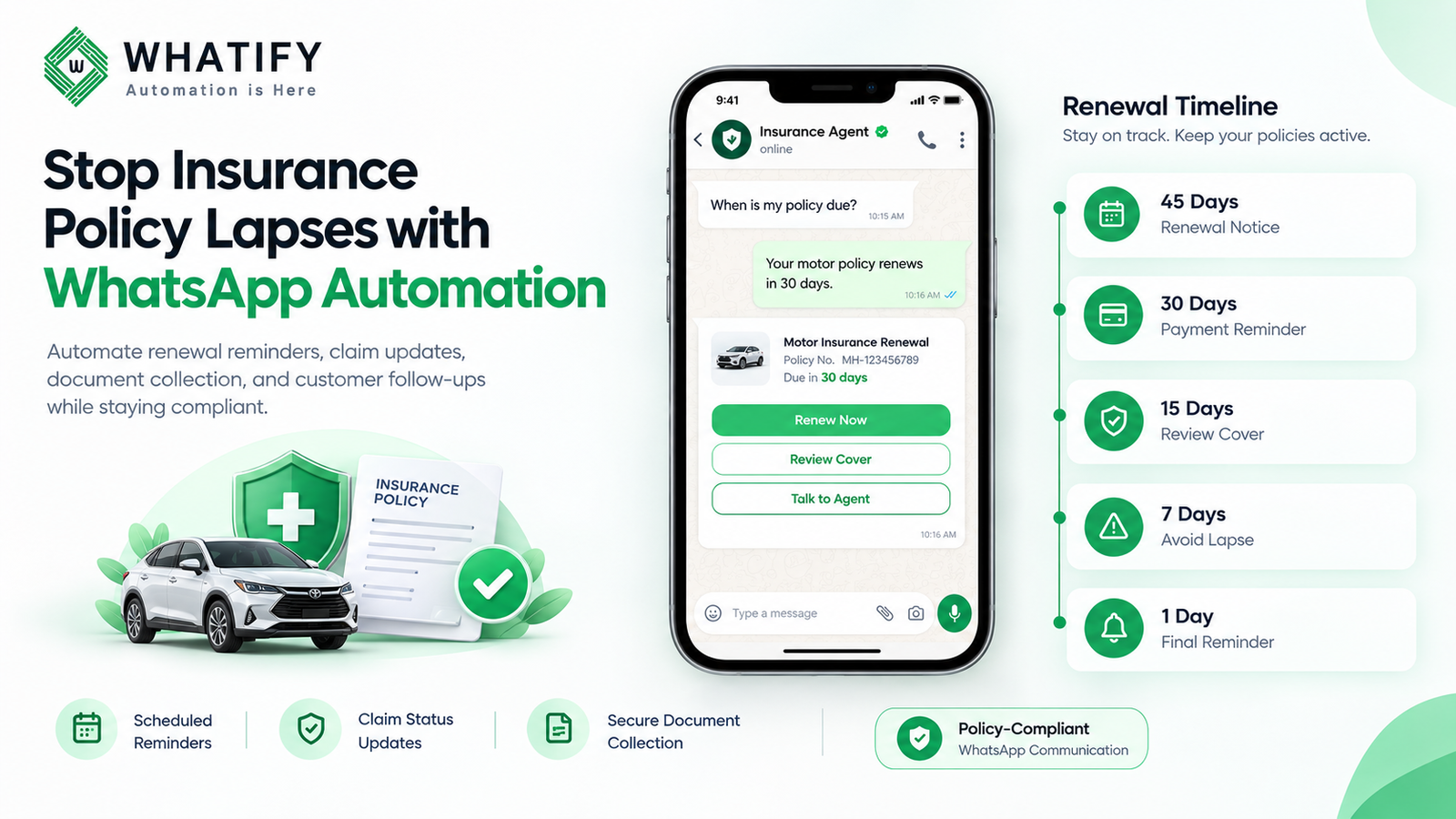
The renewal sequence
Start earlier than feels necessary. A reminder in the final week competes with the aggregator ads the customer is already seeing.
|
Timing |
Message |
|
45 days before |
Renewal due, premium amount, what the policy covers |
|
30 days before |
Reminder with payment link; flag any change in premium |
|
15 days before |
Reminder plus offer to review cover before renewing |
|
7 days before |
Urgency: consequence of lapse stated plainly |
|
1 day before |
Final reminder |
|
After lapse |
Grace period details, if applicable, then stop |
Two things make this sequence work rather than annoy.
Explain the consequence, do not just repeat the date. For motor, lapse means driving uninsured and losing accumulated no-claim bonus. For health, it can mean waiting periods restarting. Customers respond to the consequence, not the reminder.
Flag premium changes early. A customer who discovers a higher premium on the due date shops around. One who knows 45 days ahead and understands why usually renews.
Document collection
Chasing documents by email is slow. On WhatsApp a customer can photograph a document and send it in seconds.
Make it structured:
· Ask for one document at a time, not a list of six
· State exactly what is needed — "the page showing your policy number", not "your policy document"
· Confirm receipt of each
· Say what happens next and by when
For a claim, this converts a week of back-and-forth into an afternoon.
Claim status updates
The single most valuable thing an agent can automate. During a claim the customer is anxious, and silence is interpreted as bad news. A short update at each stage — received, under review, surveyor assigned, approved, settled — removes most of the inbound chasing.
An update that says "no change yet, next review on Thursday" is still worth sending.
The compliance lines
Insurance is regulated communication, and agents carry personal responsibility for what they send.
Never send by message:
· Advice recommending a specific product to a specific person without proper suitability assessment
· Claims about returns, bonuses or guaranteed outcomes
· Comparisons implying another insurer will not pay
· Anything that contradicts the policy wording
Never request by message:
· Card numbers, CVV, OTPs, banking passwords
· Meta prohibits requesting sensitive information in templates, and it is also the exact behaviour fraudsters imitate
Always:
· Use approved wording from your insurer where mandated
· Send payment links only from official insurer or authorised channels
· Keep a record of what was sent to whom, and when
That last point protects you. If a customer later disputes what they were told at renewal, a message log is evidence.
Consent and record keeping
Take explicit opt-in, separately for policy servicing and for marketing. Store when and how it was given. Insurance customers are particularly sensitive to unsolicited contact, and an agent's reputation is their business. Our guide to DPDP consent records covers the six fields to keep.
Cross-sell without damaging trust
An agent with a book of motor clients also has a book of people who need health cover. The temptation is to broadcast. Resist it.
Time cross-sell to a relevant moment: after a successful claim settlement, at renewal when the customer is already thinking about cover, or on a life event you actually know about. One relevant message beats twelve generic ones, and generic insurance broadcasts generate blocks quickly.
Frequency discipline is not optional here — see our quality rating recovery playbook.
Costs
Renewal reminders and claim updates are utility templates at the lower rate. Cross-sell and promotional messages are marketing templates. An agent with 800 policies running a five-message renewal sequence should model the annual cost against commission before automating everything — our cost per message guide has the method.
Where to start
Build the renewal sequence first. It has a directly measurable return: renewal rate this year against last year, for the same book.
Then add claim status updates, which reduce inbound calls more than anything else.
Whatify supports scheduled sequences driven from a Google Sheet or your own system, so a policy expiry list can drive the whole renewal cycle. Start a 14-day free trial with a single month's expiries.
EXTERNAL SOURCES
1. Meta — WhatsApp Business Messaging Policy: prohibition on requesting sensitive information and rules for financial services messaging. https://business.whatsapp.com/policy
2. IRDAI — Insurance Regulatory and Development Authority of India, for current rules on agent communication and advertising. https://irdai.gov.in/
3. Meta — Message template guidelines: utility categorisation for renewal and claim status messages. https://developers.facebook.com/docs/whatsapp/business-management-api/message-templates/
Frequently Asked Questions
Around forty-five days before the due date, with follow-ups at thirty, fifteen, seven and one day. Starting in the final week means competing with aggregator advertising the customer is already seeing, and leaves no time to discuss a premium change before the deadline.
Most reminders simply repeat the date. Customers respond to the consequence — losing accumulated no-claim bonus on motor cover, or restarting waiting periods on health cover. Stating what lapse actually costs is more effective than another reminder of when payment is due.
Do not send product recommendations without a proper suitability assessment, claims about guaranteed returns or bonuses, or comparisons implying another insurer will not pay. Never request card numbers, CVV, OTPs or banking passwords — Meta prohibits it and it mirrors fraudster behaviour.
Request one document at a time and describe exactly which page or detail is needed, rather than sending a list of six requirements. Confirm receipt of each item and state what happens next. This typically compresses a week of email exchanges into a single afternoon.
Yes. During a claim, silence is read as bad news and generates anxious calls. A short update saying there is no change and naming the next review date reassures the customer and reduces inbound chasing more effectively than waiting for a decision.
Ready to automate your WhatsApp marketing?
Start your 14-day free trial today. No credit card required.
Start Free Trial